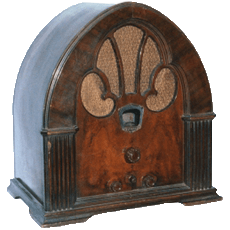
Peter,
first welcome.
Second, tell your wife to never plug anything that she does not know whether it works or it doesn't, in. And don't do that yourself either.
This was a violation of one of the bigest No-nos of antique radios, and anything antique, rules.
Now, this is the link to the thread of my restoration of a 96 Hiboy that I have very recently (spring of the last year) finished.
https://philcoradio.com/phorum/showthrea...=philco+96
Keep in mind (I do not know if you have experience in these matters): this is a serious project and can take a while.
And tube electronics is inherently dangerous if disrespected.
Now.
1. Unplug the speaker (it is a regular Philco round backelite plug in the back, on thetop surface), and measure
Look in this article.
https://philcoradio.com/library/index.ph...-21-70-90/
Use the bottom figure (Speaker wiring diagram for Model 90 with 2-45 or 2-47 outputs). Pay attention to all it says.
Measure the field coil first. Make sure it shows about 3kOhm.
Note: 1. The pins could be oxidized and not show continuity even if there is one. Make sure you really provide good contact of your meter and the pins.
2. Try to not touch these with both hands when measuring. As a kid I got a little but unpleasant shock when doing it with an analog meter. Inductance, you know.
If the coil is open, you have a problem. Likely you will need a new speaker.
3. If the coil is OK, now measure the transformer, both halves of the primary. Should be on the order of 300 Ohms or so. If open, it is not as bad as having an open coil, but you will need a replacement transformer.
If the speaker, or at least the Field coil of it, is good, proceed, otherwise stop: you will need to discuss your options.
2. Take the knobs off.
3. Remove the chassis, put in on your bench.
4. Remove all tubes. ALL.
5. Make sure your power cord is not shorted/frayed/cracked. Turn the ON switch clockwise, hear the click. Measure ohms across the prongs. (again, try to keep the hands from touching). Make sure you provide good connection, rub the leads agains prongs if needed.
- If open, check the switch (you will have to open the chassis from the bottom).
- If the switch is bad, look up my thread, it should tell you what to do (spray contact cleaner in thos small openings in the switch's wafer)
- If good, nake sure the trensformer is not open.
If your trasformer / cord / switch are good, or you fixed it that it has continuity, you should now use a Variac.
6. Using a Variac. Or (oh my Gosh, I can't believe I am saying this) DimWit Tester. OK, ,Dim Bulb tester.
I only am mentioning the latter because I can see you are new to this and probably lack the equipment.
Variac - connect the variac to the wall outlet, set to 0V.
Plug in the chassis.
Put a Voltmeter across the filament pins of the Rectifier tube (80).
Turn on the Variac and slowly turn the knob CW, watch the Voltmeter. The voltage should start rising to a few voltas (5V at 110V setting).
If it is OK, you can exhale, your transformer is good. If you hear loud buzz, see the variac fuse pop or the Variac itself not raising the output voltage oy its own meter, your transformer is bad.
Let's stop here.
I think it is enough for the start.
Mike.