Posts: 23
Threads: 1
Joined: Nov 2025
City: Madison
State, Province, Country: Mississippi
Posts: 3,188
Threads: 226
Joined: May 2008
City: Omak
State, Province, Country: WA
Hello eewill,
First all let me say welcome to our little world of Philco and far as that radio goes That was from their 1936 line introduced in june of 1935 . I have what they call the model 610B yours is the model 620B here you find the 1936 year lineup on our Philco Gallery . philco gallery
your set sold for a whopping $49. when sold brand new .
To answer your question that set is a good one to restore and the chassis looks original and I would go for it
you have a lot people here that can help and aswer questions here is a link to the schematic in our Philco libary
Philco 620
Sincerely Richard
Posts: 18,427
Threads: 622
Joined: Oct 2011
City: Jackson
State, Province, Country: NJ
Just yesterday I put the 620 chassis I restored in...2016 in the cabinet that I just got from restoration.
It actually sounds pretty nice.
This is my thread on it. There are a few more. You might find some info helpful.
https://philcoradio.com/phorum/showthrea...philco+620
Overall, properly restored, it is a very nice radio.
People who do not drink, do not smoke, do not eat red meat will one day feel really stupid lying there and dying from nothing.
Posts: 5,584
Threads: 291
Joined: Nov 2012
City: Wilsonville
State, Province, Country: OR
Welcome to the Phorum!

That's a perfect radio for restoration in my view. I like them a bit crusty to start with. Of course whether its worth it to you depends on what you want to do with it. You can easily put more money and effort into these restorations than you will get back if you try to sell it. For me its just a hobby I enjoy. I get a charge out of seeing the old relic come back to life and look more like it did when it was new. I've sold a few, given away a few, donated some to charities and kept a few.
Yours seems to have a good grill cloth although I'll bet its pretty fragile at this stage. The cabinet looks pretty solid, the chassis appears dirty but not too rusty. As long as the IF, audio and power transformers are OK you probably have a winner.
Posts: 23
Threads: 1
Joined: Nov 2025
City: Madison
State, Province, Country: Mississippi
Thank you for the welcome! I'm definitely considering a restore. It looks a little daunting right now. I'm used to nice neat circuit boards and what is under that chassis looks like a mess!! lol. I have no idea the condition of any of the components or how to go about testing the tubes. Definitely not going to plug this thing in without a little more confidence on the state of things.
My first thought would be to pull everything off clean and test. That could be quite a puzzle to put back together!
The grill cloth is actually in very good condition and surprisingly not very fragile. The paper on the speaker LOOKS good, but it IS very fragile and has come unglued on the edges. It definitely needs a new power cord. Would love to have something like the original braided cable. The other braided wires are probably ok.. just dusty, dirty and old.
I'll have to read around on here to see what the best approach to start working on this would be.
Posts: 5,584
Threads: 291
Joined: Nov 2012
City: Wilsonville
State, Province, Country: OR
Definitely do some reading on restoration of tube radios and take a look at some of the many restoration threads within this Phorum. While its not part of our web/forum, Phil's Old Radios has a nice write up for beginners in the hobby.
Our digital library has a good set of service info https://philcoradio.com/library/ and the documents section has lots of other Philco related info. The Shop Talk section has a lot of helpful tips on techniques (along with our late founder's personal website postings in Ron's Radio Archive). Our Resources section of the library has places to buy some of the components you may need.
The speaker cone can likely be repaired. All the paper capacitors will need to be replaced along with the electrolytics. Out of spec (off by more than 20% or so) resistors need changing. You'll want to become familiar with the schematic symbols and check for bad transformer coils. Those can sometimes be repaired depending on your skills but can require a replacement.
Tubes are often good even in radio as old as yours but testing requires a tube tester. Most of us in the hobby have one so you may be able to find someone local to help you with the testing or there may be a vintage radio club someplace near you.
Posts: 1,797
Threads: 55
Joined: Feb 2015
City: Roseville, MN
Hi eewill,
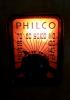
Welcome to the Phorum. One thing to keep in mind is to take photos before taking anything apart. We often get distracted or something causes a pause in the project and if you don't have photos to remind you how things were then you can get headed down the wrong path. One other point I noticed from your photo, it appears someone tried cleaning the dial and used water or a water based cleaner. Well, you can see what happens in that case. The dials from this era are printed with a water based ink, so using water to clean the dial is not recommended. You can use mineral spirits and a soft cotton cloth or cotton swabs to gently clean the dial. And speaking of dials I believe your dial assembly teardown and rebuild is covered in the Philco Library Service Info section.
Posts: 18,427
Threads: 622
Joined: Oct 2011
City: Jackson
State, Province, Country: NJ
All that needs to be said have been said, so I have little to add to that.
If this is your first radio, as has been suggested, do some reading.
Don't plug it in.
Replace all the caps.
If you plan to keep doing this after this radio (very likely; most of us wanted that one radio restored...and look at us now), get some decent tube tester (the prices have come down a bit).
Hickok 800 or 600A are good basic mutual conductance testers and will test most if not all tubes.
I have just listened to this radio in my basement with 3-ft dangling wire for the antenna (earlier when i wrote about it, I had me touching the antenna clip); sounds good. Our local station transmits music round the clock exactly at 1160 AM, very convenient for the first check.
People who do not drink, do not smoke, do not eat red meat will one day feel really stupid lying there and dying from nothing.
Posts: 18,427
Threads: 622
Joined: Oct 2011
City: Jackson
State, Province, Country: NJ
Can't help asking: does EE in "Eewill" stand for Electrical Egineer?
People who do not drink, do not smoke, do not eat red meat will one day feel really stupid lying there and dying from nothing.
Posts: 23
Threads: 1
Joined: Nov 2025
City: Madison
State, Province, Country: Mississippi
@morzh - That's correct. Electrical Engineer. But while I find this radio's circuit fascinating, I have no idea how the vacuum tubes work! A little before my time.
Also, you know, I'm itching to plug it in to see what will happen! I understand the need to replace the caps though. Right now, I'm just trying to go over the hole thing and clean it up. It's filthy with dust and small debris. It would be really nice if someone had a list of caps that are recommended to replace. I'd start by getting those. Otherwise, I just need to go over the schematic and see what's there.
@RobB - Absolutely. I'm taking plenty of pictures! Yeah, I notice the dial is missing some of it's printing. I've already figured out how to remove it so I can clean. Are replacement dials available? I haven't tried looking yet.
@klondike98 - Thank you! I have already starting looking at the resources there. Lots of good information.
Posts: 5,654
Threads: 56
Joined: Sep 2008
City: Sandwick, BC, CA
Those Olson brand caps are replacements from the 1950s or 60s, they used to be a discount mail order house that not only sold parts, but kits, and early Japanese import electronics, sort of like Lafayette Radio. I believe that most of the original paper caps were of the Bakelite block type which the Olson brand ones are either bypassing or are connected across. The Bakelite blocks can be restuffed and Morzh (Mike) has worked out a method to do so without disconnecting the wires from the terminals on top. The filter cans can also be restuffed, and are large enough to fit larger value film caps inside if you want to go that route. The resistors may or may not be still in spec, those body-end-dot code resistors, of the dog bone style, often like to drift in value.
One thing that you may find useful is a larger soldering iron of 100 Watts or more, you can probably find someone with a tube tester that you can borrow. There is a fellow that comes on here sometimes who lives in Meridian, Mississippi by the handle of Radiotvphononut, he has a Y.T channel, maybe he can help?
One more thing, whilst you are cleaning don't use water to clean the dial, or the letters and numbers will wash off oft it, dry dusting, followed by mineral spirits.
Regards
Arran
Posts: 1,135
Threads: 54
Joined: Feb 2013
City: Shenandoah,
State, Province, Country: Pennsylvania
Hi Eewill, I have that very same radio I restored 8-10 years ago and it is a decent performer so yes it’s worth restoring. I know it’s very tempting to plug it in but don’t until at the very least the electrolytics have been replaced. When you have it ready for a test run, it’s probably in need of an alignment so a signal generator will be needed. If you need a new dial, radiodaze.com is a good source for that dial and other parts…https://www.radiodaze.com/philco-620-630-27-5098/.. Enjoy your project.
Ron
Bendix 0626. RCA T64 Philco 20B
Philco 41-250. Philco49-500
GE 201. Philco 39-25
Motorola 61X13. Philco 46-420 Crosley 52TQ
Philco 37-116. Philco 70
AK 35 Philco 46-350
Philco 620B. Zenith Transoceanic B-600
Philco 60B. Majestic 50
Philco 52-944. AK 84
Posts: 553
Threads: 89
Joined: Jun 2022
City: Marion
State, Province, Country: NY
I would definitely take this radio on and restore it. I had (sold it) a Philco 650 with same cabinet. It turned out very nice after I did my magic on it. I have the 620 in a different cabinet. The chassis was very dirty but no rust. I fully enjoyed working on it. I am not an expert by any means.
My advice is same as others. Just take your time and pay attention to the details. I take pictures and sometimes find they are not adequate when I need to see just where something went. Oops picture was not good enough but lucky I can figure it out after consulting the schematic. So now I take notes and draw pictures along with pictures.
Good luck and enjoy.
Dan
Posts: 18,427
Threads: 622
Joined: Oct 2011
City: Jackson
State, Province, Country: NJ
Eewill
Yeah, me too. An EE. Educated as a physicist though, self-taught otherwise.
Grew up around tubes but practiced with transistors mostly as an amateur in end of 60-s to 70s. Graduated as a Soviet specialist in physics (give or take, an MS); join a factory to repair NC machines. Then a software research facility, as a computers (PDP-11 and what else we had) service guy. Then immigrated here.
Did some power in 90s, then switched to hi-speed telecom, until almost 14 years ago came to work here and became a GP guy (all-around). A this point the only EE in my division.
Still practicing but nearing the "throw in the towell" line 
When young, I tried tubes, but then kept mostly at solid state, and eventually started with old radios and amps some 14 years ago.
Tubes....well, if you understand MOSFETs well, you understand the tubes. Different voltage range, but otherwise very similar.
You'll have fun, especially after a couple of zaps (if you survive) only kidding.
Welcome!
People who do not drink, do not smoke, do not eat red meat will one day feel really stupid lying there and dying from nothing.
Posts: 1,797
Threads: 55
Joined: Feb 2015
City: Roseville, MN
There's a reproduction dial available from Radio Daze but it's pricey.
https://www.radiodaze.com/philco-620-630-27-5098/
You might want to wait until a parts 620 comes along. It's not like the radio won't work without it.
Users browsing this thread:
|
|
Recent Posts
|
|
Plug Voltages Needed For A 1943 CRV-20130 Power Supply
|
| That looks a lot like an aircraft connector of some kind, even if it's a U.S.N power supply. I have a book somewhere abo...Arran — 02:56 AM |
|
Plug Voltages Needed For A 1943 CRV-20130 Power Supply
|
| hello david,
I have a similar generator in my collection that features a cast iron, single-cylinder Briggs & Stratt...radiorich — 01:00 AM |
|
under chassis parts locator diagram for 1938 Zenith 9s262
|
| Has anyone gone to the trouble of creating an under chassis parts locator image? Yes, I can identify components by foll...bobloney — 08:57 PM |
|
Plug Voltages Needed For A 1943 CRV-20130 Power Supply
|
| Try looking at this site the book mark is for a old generator that I was given. David https://radionerds.com/index.ph...David — 08:36 PM |
|
Plug Voltages Needed For A 1943 CRV-20130 Power Supply
|
| Hello Everyone,
I am looking for voltage identification for all the pin positions on the socket of a CRV-20130 power su...Tonym4704 — 08:16 PM |
|
Philco P45-6365 Universal Transformer Instruction Manual
|
| Can anyone guide me to where this may be found?GRG — 03:00 PM |
|
54C Complete Teardown/Rebuild
|
| I don't think that I have encountered a 12Z3 before, curious how it uses one of those but includes a #43, which is a 25 ...Arran — 02:17 PM |
|
HiFi (Chifi) tube amp build - but my own design.
|
| It's the other forum. I'm also in DIY, but mostly read there. Honestly, I kinda jumped into this without much thought to...TV MAN — 10:43 AM |
|
Philco 71 Code 125
|
| Hello,
I am in need of a schematic for this radio. Mine has the three separate circular tube shields and a shadow me...dconant — 08:06 AM |
|
Stromberg Carlson 1500 Squeal
|
| And life just keeps getting more complicated.dconant — 07:57 AM |
|
Who's Online
|
| There are currently no members online. |

|
 
|