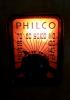
There is no model number on the inside of this nice wood cabinet or on the chassis. Therefore I can't reference any schematic to rebuild it. I believe it was sold in Canada in the late 1930s. What makes it unique are the preset buttons and the rounded upper corners. Any help is appreciated.
Thanks for the quick reply. There were no markings of model number and I think you nailed it. Now I have somewhere to start. Much appreciated. I have about 5 Philcos in various states. I love the cabinetry.
It could be a Canadian model, or it could be a U.S import. If Canadian they usually had a model number plate riveted to the chassis, but one thing that it would have is a radio license notice sticker plastered somewhere either on the bottom, or inside the cabinet. One would think that they would have added an extra IF amp to the Canadian version with the pushbuttons, but I don't think they did. You can also look through the battery models on this page and see if it matches one of them, Philco Products of Canada used a different model numbering system then the U.S ones did. https://pacifictv.ca/philcoschematics.htm#philco
Regards
Arran
(This post was last modified: 03-30-2026, 03:00 PM by Arran.)
First off, welcome to the Philco Phorum, a family-friendly (or Phamily-Phriendly) place of radio hobbyists interested in the Philco brand and antique radios in general.
Please "surf" this site, read the Rules and Regulations, and "What NOT to post". We have various topic forums for chassis and cabinet restoration, radios other than Philco, TVs, Audio, Test Equipment and the Trading Post, where to place "For Sale" and "Wanted to Buy". Don't forget to stop in at "Old Ron's Bar and Grill" for a virtual burger and brew and to shoot the breeze with the gang about almost anything'
Now to your radio:
Take a look at the tube compliment. If they match the schematic for the 40-100, you are on the right track. This is a 4 tube superhet radio that runs on a 1.5V A battery and 90V B Battery. In this case, the 2 batteries were contained in the same package. You can run it on a 1.5V alkaline D cell and 10 9V batteries in series. though it won't run for long, it will run for a few hours. The schematic and tube compliment do not vary by much other than part values. The tubes are:
a 1A7 Pentagrid Convertor
a 1N5 IF Amp (Ensure that the tube is shielded and that the shield is grounded to the chassis)
a 1H5 Diode / Triode Detector / AVC and 1st AF Amp (If the tube and grid cap are not shielded, dress then against the metal of the IF transformer can.)
A 1A5 Audio Power Output tube
Note that there is a resistor in the B- line between the battery and Chassis ground. This is to develop the "C-" necessary to bias the Audio Output tube and the 1st AF tube.
Please note that you will not be able to detect a glow from the tube filaments in daylight or room light. Even in a pitch black room, it will be difficult to detect a glow. If they glow at all, it will be an extremely dull red. Therefore, don't trash these tubes just because you can't see light.
These tubes were developed by Sylvania in around 1938 and replaced the tubes used in many battery sets since about 1930 or so whose tubes' filaments ran on 2volt storage batteries. These 4 tubes spurred the development of portable radios that became extremely popular, in addition to the "farm" sets. The portables were very similar to the farm set circuits except that portables were developed that were operable on house current. This involved wiring the tube filaments in series and adding a 117Z6 or similar rectifier tube or a selenium rectifier. Farm sets were generally not wired for battery or house current operation, as the farm generally lacked utility power. Convertors became available but were not popular because when power finally arrived to these farms, the farmer generally opted for a new radio that had between 2 and 5 watts or more of power. The tubes were changed to 7 pin miniature tubes around the time of WWII but the circuits remained similar. This 4 tube battery radio lasted into the late 1950s when the transistor was finally commercialized and became somewhat affordable. Though much more expensive than the 4 tube portable when they first came out, the savings in batteries paid for themselves in a short period of time.
While these sets do not generate the level of heat that bakes resistors and capacitors to failure, it is still a good idea to replace all caps, especially the 10 uF electrolytic across the B Battery. Despite the pure DC feed, the cap is necessary to prevent oscillation or instability.
The 1A5 develops only about 100 mW of power. The 1Q5 develops almost twice as much. Though it uses a beam power tube, the pinouts are the same. However, to take advantage, the bias resistor, #18 and the output transformer must be changed. The output transformer for a 1A5 is about 20KOhm primary impedance. The 1Q5 needs an output transformer with an impedance of about 8KOhms.
Hope this helps.
"Do Justly, love Mercy and walk humbly with your God"- Micah 6:8
"Let us begin to do good"- St. Francis
MrFixr55 Wrote: This is a 4 tube superhet radio that runs on a 1.5V A battery and 90V B Battery. In this case, the 2 batteries were contained in the same package.
I have been collecting radio battery information for years. The parts list for the Philco 40-100 calls for a Philco P 60D-11L battery. This battery and its equivalents appear to be the most used battery type in '40s farm radios. An equivalent battery was available from most of the battery manufacturers. Possibly the most sold equivalent was the Eveready 759.
I own a 1946 Motorola 45B12 farm radio which uses the same battery, but which I have not yet restored. I plan to build a battery eliminator disguised as an Eveready 759. I have the artwork for that battery and the socket which goes in the top to receive the battery plug. I will install a socket to match a TV cheater cord in the side of the battery towards the chassis. Looking in the back of the radio with the cheater cord unplugged the radio will appear to be powered by an Eveready 759 battery. With the cheater cord plugged in to provide AC power to the battery eliminator the Motorola will operate.
One interesting note about the Eveready 759 battery is that the battery cable in my Motorola has a 4-pin plug (apparently a JFD No. 707), and my Eveready 759 artwork is for that plug. Radiomuseum has a photo of the top of a 759 with three two-pin sockets. At the ends are two 45 volt batteries, and in the center is the 1-1/2 volt battery. I do not know whether that photo is older or newer than my artwork. I have never seen elsewhere an Eveready 759 with three sockets - only with one socket.
Dale, that's interesting. I have a BF Goodrich Mantola R419 portable. (one of the 1st gen models of portables that came out in 1938). Belonged to a great-uncle. Had 2 45V bricks and 1 1.5V Brick and the requisite 3 plugs.
Just looked at the RadioMuseum pix. First off, that battery is GARGANTUAN, much bigger than the batteries in my portable and about 1.5 times the size of the battery area of my portable.. However that is to be expected as the farm sets were stationary. However, it seems that there are plugs at the top and bottom. The first pic shows a guy holding the battery. The second pic shows the 4 pin jack on the top right (or left depending on point of view and orientation) and the 3 jacks you mention at the bottom. As if it was to be a universal battery for sets using those voltages (and there were many).
"Do Justly, love Mercy and walk humbly with your God"- Micah 6:8
"Let us begin to do good"- St. Francis
I don't know when that three-socket Eveready 759 was made, but the only ones I have seen are single-socket, conforming to the NEDA standard 413 battery.
BTW, Great info from you, Dale, as always. I am always amazed at the knowledge that you and others bring to this group! You should add "Battery Expert" to your moniker.
Those separate sockets are at the bottom. I don't remember if the photos came from someone here or in Europe.
Do you have a lot of battery powered radios or farm radios? I have 4 farm sets. Two of these are RCA; a 6BT (BC / SW and a separate chassis) and a 5BT. (BC only). These sets have 2V filament tubes and 135V B+. The 6BT has an option (which I don't have) for a vibrator power supply to run the whole thing on a 6V battery; 2V for the tubes and 4V for the vibrator B supply. The 6V storage batteries back then had the cell-to-cell links above the top cover of the case, allowing this arrangement and allowing for even discharge of the battery. Both sets and the spare chassis are restored and functional. The 3rd set is a Coronado 650 that runs on a 2V battery or air cell and 90V B Battery. This set has 2 Sylvania 950s in parallel to put out only about 1/2 watt. Currently not working; a mouse took a liking to the oscillator coil. This set must have been somewhere near the Great Lakes as it had a wave trap at the IF frequency which was also used for navigation and CW communications on the great lakes and canals.
The last one is a 1941 RCA 14BT2. This called for a Burgess 17GD60 battery which appears to be similar to the Eveready 759 in dimensions. An adaptor was available from RCA for separate batteries. Right now, I am using one of the Silvertone "PowerShifter" a /B battery eliminators.
It is interesting how regionalized Farm Sets were. Some ran on 6V where car batteries and Wind Chargers (Win-Charger) were available, some ran on 32V where DC Farm Power Plants and Battery banks were available and the ones that ran on batteries where no mechanization was available. Some of the Zenith 6V sets were sold with dual power where electrification was anticipated.
I grew up in Suburban Long Island NY. Prior to WWII LI was famous for potato and duck farms. A parasite killed the potato farms off, making cheap land available for the suburban develpment boom that took place from 1947 (Think Levittown) to the early 1970s. Duck farming lasted on the east end of Long Island into the 2000s because the Ducks here were perfect for Peking Duck.
"Do Justly, love Mercy and walk humbly with your God"- Micah 6:8
"Let us begin to do good"- St. Francis
MrFixr55 Wrote: I am always amazed at the knowledge that you and others bring to this group! You should add "Battery Expert" to your moniker.
I am an inveterate hoarder and organizer of information. I have compiled a lot of information about radio batteries, and have done that mainly to help others.
MrFixr55 Wrote: Do you have a lot of battery powered radios or farm radios?
Aside from a couple of '20s TRF sets and a pair of fairly recent pocket/belt personal receivers, I have just the 1946 Motorola 45B12 farm radio and an H-500 TO, which is as old as I am.
MrFixr55 Wrote: The last one is a 1941 RCA 14BT2. This called for a Burgess 17GD60 battery which appears to be similar to the Eveready 759 in dimensions.
The two are equivalents. The are both NEDA number 413 batteries.
I have maybe two dozen battery catalogs, a few in print and the rest in PDF. That doesn't count catalogs such as RM/REM, Allied, Newark, et alia, of which I have many.