Potential Silvertone 4577 Acquisition
Posts: 172
Threads: 10
Joined: Mar 2026
City: Franklin
State, Province, Country: Maine
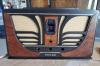
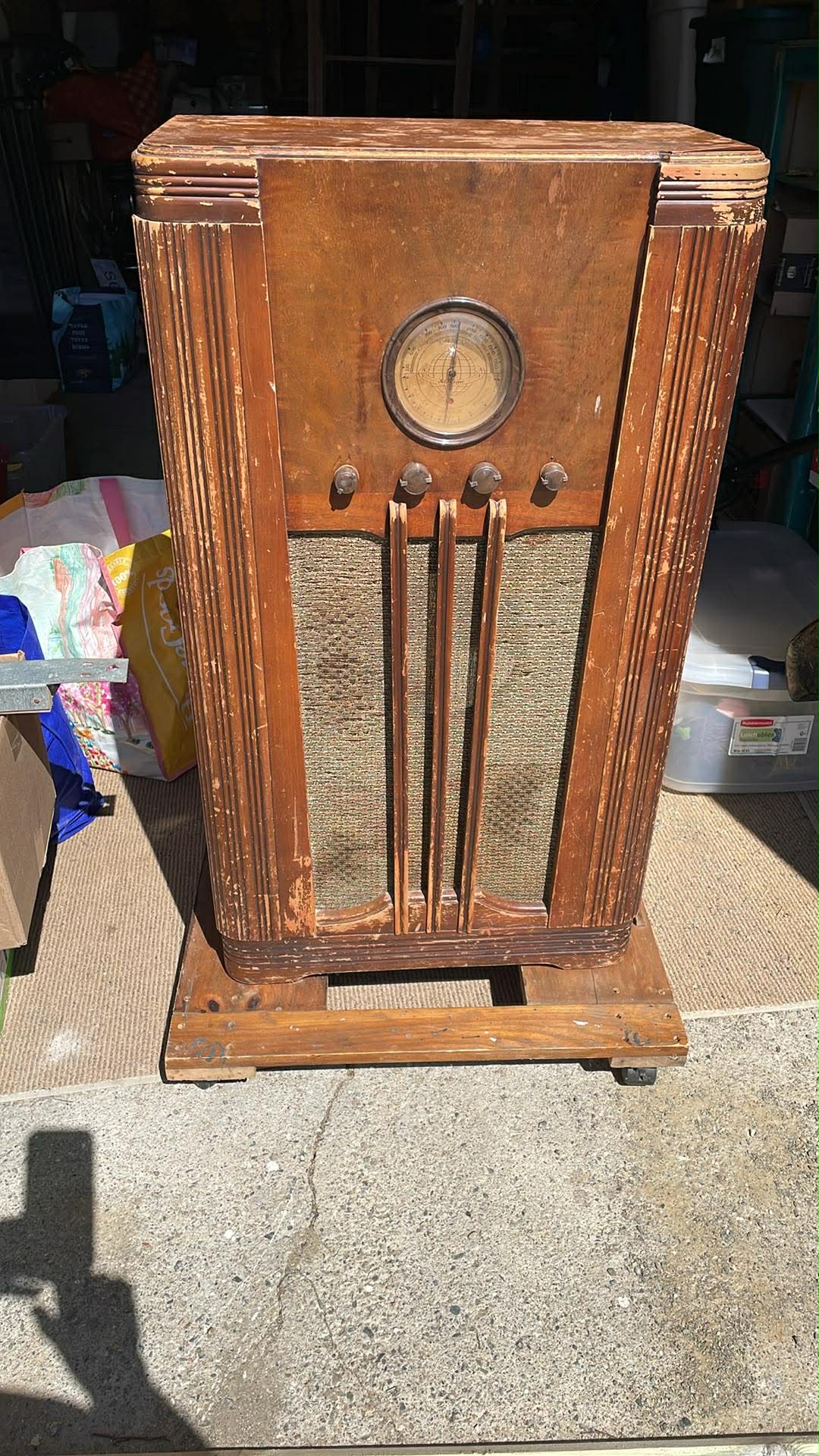
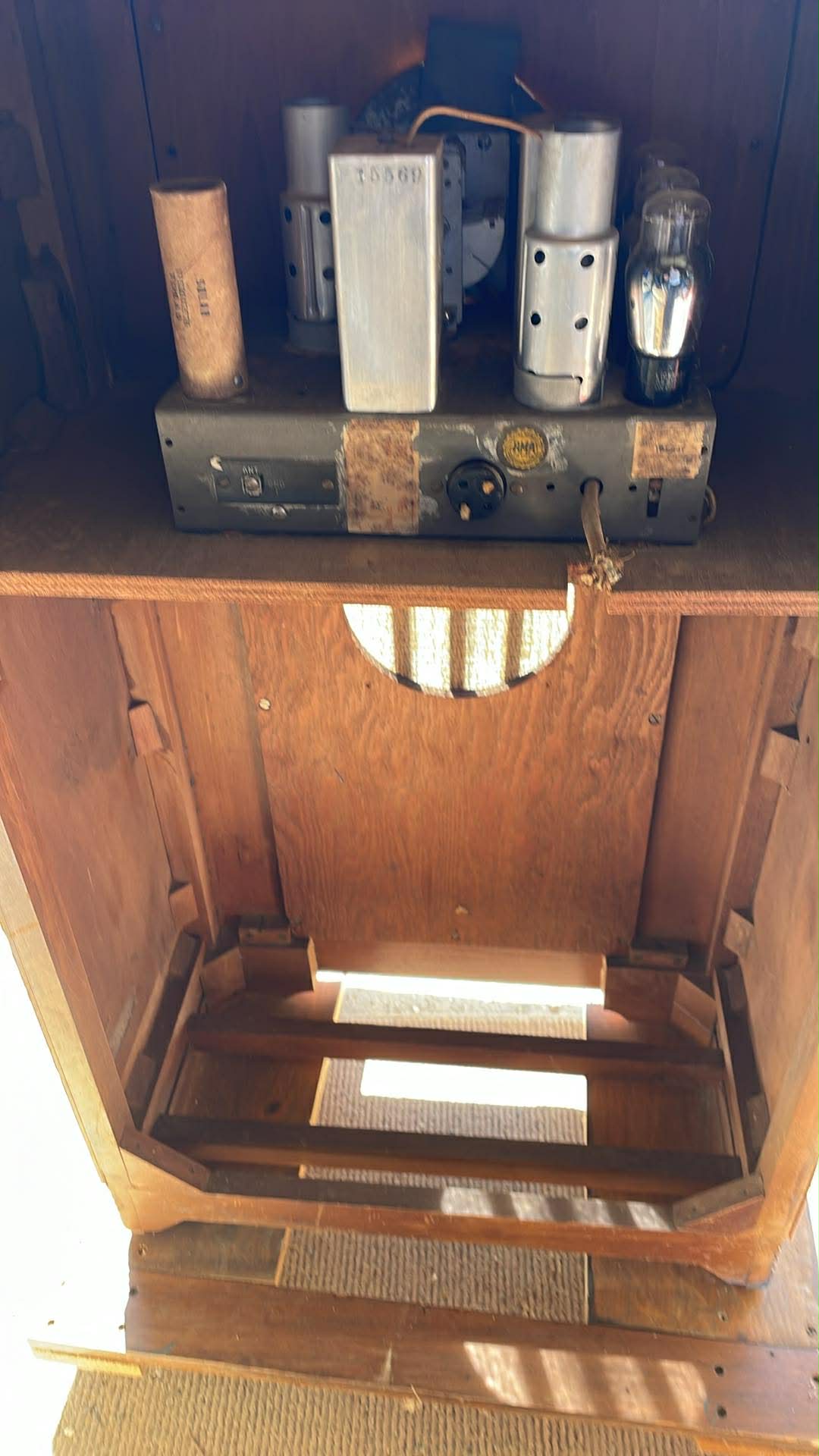
I'm hopefully going to look at a different radio (from the one in the title) later today ( one of these) but the seller also has most of a Silvertone 4577 that he wants to part with as well. It's a console model, and from what I can tell, the 4577 is one of those battery-operated jobs that seem like so much fun to power these days. It is missing the speaker, so it's basically just the cabinet, the finish of which is a little rough, and only the chassis.
I have no great desire to get this Silvertone, and as I said, I understand the battery-operated models seem to be their own special ball of wax, but it's also interesting in that there doesn't seem to many records about this model. Radio Museum doesn't have a single photo, though I did download a copy of their schematic.
Is it just an unfair impression of mine that Silvertone as a product of Sears is probably a lower-end model in the first place? Given the missing speaker, if I were to try to get this fixed up, would it make sense to adapt this to a newer, permanent magnet one? Is it not even worth the effort with this chassis, and maybe just try to upcycle the cabinet? It is at least structurally sound from the photos - the owner wanted to put shelves in it and make it a rolling bar cart.
Best wishes,
Roy
Posts: 18,427
Threads: 622
Joined: Oct 2011
City: Jackson
State, Province, Country: NJ
Some Silvertones do look great and sound great.
After all, none of those during those years were made in China.
People who do not drink, do not smoke, do not eat red meat will one day feel really stupid lying there and dying from nothing.
Posts: 1,797
Threads: 55
Joined: Feb 2015
City: Roseville, MN
Too many "ifs" to put any money into it and there's considerable time spent getting it to the point of applying power. Having the replacement parts on hand would be a starter. Then once you have it running you have an unknown Silvertone. Maybe it'll look good sitting in a corner after cleaning up the finish. And push buttons, how many does it have?
Posts: 172
Threads: 10
Joined: Mar 2026
City: Franklin
State, Province, Country: Maine
Rod,
No push buttons on this model. It's a 1936. The dial is actually I think one of the nicest features about it, in that it still looks pretty good for its age. The cabinet is rather plain, but again, looks structurally sound. That's why I was thinking if nothing else, it might be a good option for a modernization. Certainly the details on the cabinet would make for good practice for woodworking/refinishing.
Even if it was a low-end model (which I'm not sure that it was), I always feel a little sympathetic for rarities, whether they are prized or not.
Best wishes,
Roy
Posts: 5,654
Threads: 56
Joined: Sep 2008
City: Sandwick, BC, CA
In answer to your question, yes you could put in a more modern, or vintage P.M dynamic, you may need an output transformer for it though unless it's mounted on the chassis somewhere. Other then the speaker it looks like it's fairly complete, and in decent shape, and one advantage with a console battery set is you have all the room in the world to house a power supply. Here is the schematic from Riders, posted on Nostalgia Air: https://www.nostalgiaair.org/pdfs/Sears-...o-4577.pdf
It's kind of an off one in that it has a 1E7 power output tube, but the two sections are run in parallel rather then push-pull. It's also interesting that it requires 4.5 volts for the tube filaments rather then 2 volts, B+ is only 90 volts, no 135 volt tap. Anyhow there is no rush to do anything with these old sets, put it aside and keep it for a later project or maybe offer it in trade for something more of interest? Bluetoothing or "upcycling" just turns a vintage item into dumpster fodder for later.
Regards
Arran
Posts: 172
Threads: 10
Joined: Mar 2026
City: Franklin
State, Province, Country: Maine
Arran, thanks for the complete schematic and advice. No, there certainly is no rush for this and you're right, plenty of room to accommodate power sources.
Best wishes,
Roy
Posts: 2,327
Threads: 23
Joined: Jul 2020
City: Greenlawn
State, Province, Country: NY
Glyphmon, if cheap enough, I say go for it! BTW, I have the AM only version of the R28. It is an interesting set to say the least, a "transitional" set with an RF amp, pentagrid convertor , no IF amp, a biased detector and new tech 2A5 output tube which replaced the '47. Eventually, the power detector was replaced with a Diode / triode detector / 1st AF amp, the RF tube disappeared, an IF tube was added and Voila, the standardized 5 tube "AA5" circuit (transformer powered version). It was RCA's loss leader for the year until Philco came out with the 80 Jr and undersold them by $10.00 and started a price war.
Although I have spent my whole life in Suburbia, I have always had an interest in Rural America, especially in the latter part of my career where I provided phone support and occasionally on-site support to rural Hospital Laboratory customers. Rural America faced many different problems than urban and suburban America, especially during the Great Depression, dust bowl and WWII. "Intellectuals" disparaged rural folk as "hayseeds", but these people dug the coal mines, drilled the oil wells and raised the crops and meat that fed us, and we would not have been a country without them. I'm not sure how many Ivy League college "Poly-Sci" (Political Science) graduates could feed themselves and others. Farm Sets have a lot of history in them and were an example of the issues faced in delivering entertainment and news to very hard-working people who did not have electricity and possibly did not even have mechanization. This set is an example as it was designed to be powered by disposable primary batteries as opposed to a storage battery. The set was likely listened to very sparingly, for news, religious programming if travel to church was difficult and very occasional entertainment. The fact that it was powered by disposable batteries is a possible reason for the low power output.
I would not think of these sets as being "cheap"; look at the strength of the cabinet. The big restriction in these sets was not in sensitivity, it was in audio power output. This one has an output of about 200 mW, about the output of a shirt pocket transistor radio from the 1950s-m1960s, but slightly better sound from the 8" speaker. However, this set may have replaced the farmer's 10 or 15 year old Atwater Kent Model 20, Freshman, Crosley or other 3 dial TRF set that had an output of less than 100mW (more like 10-30 mW).
I am not sure who made this set; Sears had many suppliers including Arvin and Detrola.
Sears used this series-parallel arrangement on many Silvertone Farm radios of this era that used 2V tubes. Others had the filaments in parallel but had a rheostat to set the filament voltage depending on whether using 3V fry calls, 2.5V Eveready Air Cell or 2V storage cell.
The filaments of the set would run for about 30 hours on good alkaline D cells, but 4.5 Volt wall wart power supplies are not hard to find. Building a 90V power supply is not hard to do. We probably should have a permanent thread on that; it was recently discussed. I will copy paste a link to the last thread on the subject; it was thorough.
Re "Resto-mod, or Wreck-o-vation, I would not recommend the gutting of the radio chassis. The chassis is relatively easy to convert to utility power by building the appropriate power supply. Any 8" speaker will work, but a high compliance one would be best. Your biggest issue will be the output transformer. The 1E7 tube is generally run at 135V, in push-pull through an output transformer having a plate to plate impedance of about 24,000 Ohms. I think if you can find one at around 12KOhms, you will be OK. Alternatively, you could install an aux output jack and use the radio as a "tuner" to drive a hidden "Middle Kingdom" mini amp. Just make sure that any mod could be easily undone. For example, If you want to add a stereo amp and speakers, make a new baffle board and remove but preserve the original. The baffle board can support the stereo speakers and amp but also hold a speaker for the original chassis so it can be demonstrated.
Because these tubes are Series-Parallel, you want to check the filaments with a VOM or DVM. The filament pins are 2 and 7 in all of these tubes.
The tubes picked and stages are rather strange. The set has no RF amp, and a typical convertor and IF, and there is where it ends. Instead of a combination detector / 1st AF amp, the set uses a 1H4 triode as a diode for a detector, another 1H 4 triode as a 1st AF amp, the triode section of a 1H6 Duo Diode triode as a 2nd AF amp, then the 1F7 with the 2 pentode sections paralleled as the output. I don't understand the engineering reason for this. It was common to "inflate" tube count, but in a battery set, this is not a good idea. They could have used the 1H6 as the detector / AFC / 1st AF, the 1H4 as a phase invertor and the 1E7 as a push pull output and saved a tube.
If you buy this set, keep us posted. We are happy to help you get it working!
"Do Justly, love Mercy and walk humbly with your God"- Micah 6:8
"Let us begin to do good"- St. Francis
Best Regards,
MrFixr55
Posts: 5,654
Threads: 56
Joined: Sep 2008
City: Sandwick, BC, CA
Mr Fix;
I have seen power output tubes used in parallel in some Canadian Marconi battery sets, one of the other features they had was an "economy" switch on the rear which would turn off the filament on the second output tube. However this Silvertone does not appear to have such a switch, my guess is that the choice of wiring the 1E7 in that way was so they could run it in class A, rather then class B, and forgo using a step down audio interstage transformer. It also simplified the circuitry, and the operation of the set having one B+ voltage of 90 volts, which also eliminates that third "B" battery. I suppose one could "hot rod" the audio amp, since someone apparently clipped the battery cable off anyhow, adding an extra wire, and voltage is no big deal with a battery eliminator.
A lot of Sears sets were made by Colonial, which was a S & R subsidiary based in Buffalo, New York. Colonial was formed out of the remains of King Hiners, after the latter got into financial trouble. King Hiners was already a Sears supplier, so I guess they saw an opportunity for what they now call "vertical integration". Another supplier was Stewart Warner, who apparently built whatever Colonial could not supply, there are a few examples of mid 30s gold dial models that were built by both companies, but the circuitry was slightly different even if the model number was not.
Getting back to the speaker, maybe some members could keep their eyes peeled at the junk pile at some upcoming swap meets, such as a similar Silvertone with a damaged cabinet? You and I are two of the few that will even give these sets a second glance, monetarily they will never be worth as much but their performance may surprise a lot of people, even the 40s era ones.
Regards
Arran
Users browsing this thread: 1 Guest(s)
|
|
Recent Posts
|
|
Philco 45-6365 Universal IFT Instruction Manual
|
| Dale: Modified topic as suggested. It is not for a specific project. I found it in a box of stuff I recently purchased...GRG — 10:34 AM |
|
Plug Voltages Needed For A 1943 CRV-20130 Power Supply
|
|
That looks a lot like an aircraft connector of some kind ...
That is a MIL-5015 style connector, used in a wide v...DaleHCook — 10:19 AM |
|
Philco P45-6365 Universal Transformer Instruction Manual
|
| I would suggest changing the topic from "P45-6365 Universal Transformer" to "45-6365 Universal IFT."...DaleHCook — 10:08 AM |
|
Stromberg Carlson 1500 Squeal
|
| And life just keeps getting more complicated. By dconant.
Dittos'Jimradio — 08:01 AM |
|
Plug Voltages Needed For A 1943 CRV-20130 Power Supply
|
| That looks a lot like an aircraft connector of some kind, even if it's a U.S.N power supply. I have a book somewhere abo...Arran — 02:56 AM |
|
Plug Voltages Needed For A 1943 CRV-20130 Power Supply
|
| hello david,
I have a similar generator in my collection that features a cast iron, single-cylinder Briggs & Stratt...radiorich — 01:00 AM |
|
under chassis parts locator diagram for 1938 Zenith 9s262
|
| Has anyone gone to the trouble of creating an under chassis parts locator image? Yes, I can identify components by foll...bobloney — 08:57 PM |
|
Plug Voltages Needed For A 1943 CRV-20130 Power Supply
|
| Try looking at this site the book mark is for a old generator that I was given. David https://radionerds.com/index.ph...David — 08:36 PM |
|
Plug Voltages Needed For A 1943 CRV-20130 Power Supply
|
| Hello Everyone,
I am looking for voltage identification for all the pin positions on the socket of a CRV-20130 power su...Tonym4704 — 08:16 PM |
|
Philco 45-6365 Universal IFT Instruction Manual
|
| Can anyone guide me to where this may be found?GRG — 03:00 PM |
|
Who's Online
|
There are currently 1951 online users. [Complete List]
» 3 Member(s) | 1948 Guest(s)
|
|
|

|
 
|