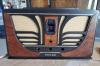
I am recapping this GE model E 106 and I can't find the C pac 20MFD,c 76 on the schematic.
It is on the drawing ,but I can;'t find it on the schematic .
I think that any information would be a help to me.
My radio has the part there [photo] but I would like a bit more clarification from someone who knows more about this,
thanks
Dan in Calgary
Hello Dan,
First of all this is mostlikely a canadian model right because I did find a schematic on Nostalgia Air and they do show is 20mf in the schematic and parts list
Sincerely Richard
I suspect this is a replacement for C35 which is across the 6F5 cathode resistor. In the chassis I restored, there was a three section box type electrolytic that contained C35, C53, and C57. It was originally located on the 6H6 side of the chassis not far from the Colorama sensitivity switch.
The wiring diagram does not show a capacitor mounted near the candohm strip as your picture shows.
I believe that it may be the same chassis as an RCA 10K. I think that is just a cathode bypass capacitor for the 6L6 tube, the schematic is drawn in a weird way, but it is connected to chassis ground. I still find it odd RCA/CGE building a 10 tube set with a single ended power output tube, even a Canadian Philco would have used a pair of #42s or 6F6s in any set with more then 7 tubes.
Regards
Arran
+1 on Arran's comments. Almost any single ended output stage will have the cathode resistor bypassed by a rather high value electrolytic cap, especially a 6L6, as it is a rather high power tube. The value (20uF) and the working voltage (25V) are dead giveaways that this is an output tube cathode resistor bypass cap.
The same schematic can be found by searching for Canadian RCA Victor Model 10K1. The schematic and tube layout diagram are marked as for CGE Model E106, Victor (Talking Machine?) Model 10K1 and RCA Victor 10K1. The same document shows the tube layout for the CGE E157, RCA Victor 15K1, and Victor 15K1. This is a 15 tube set with Push Pull 6L6s 2IFs, separate Osc and Mixer tubes, etc. So I guess you had a choice between Deluxe and Super Deluxe.
+1 on T-Bone's comments; the Canadian GE E106 is very different from the US GE E106. The tube count and type is similar except for the front end, it has 2 IF stages, it has a 6L6 output stage but the front end and detector is quite different, as well as how bias is gotten. From 1930 to 1935, RCA built all GE and Westinghouse radios. From 1920 to 1929, Before RCA bought the Victor Talking Machine Company, GE, Westinghouse and Wireless Specialty Apparatus built all RCA sets. It seems that RCA / Canadian Victor Talking Machine was still involved with CGE in 1936.
As to why this is a single ended set, especially considering the tube count, there are those who believes that some second harmonic distortion actually sounds good. I have seen the same written by pipe organ aficionados. I expect with the separate diodes for 2nd detector and AGC, this may be a rather clean sounding set.
"Do Justly, love Mercy and walk humbly with your God"- Micah 6:8
"Let us begin to do good"- St. Francis