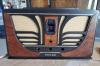
Ok, I'm new to the forum and put my introduction in the "Introduce Yourself" section.
I'm restoring a 41-295. I have two of them and I've re-capped and re-sisted one chassis. The output transformer on the restoration unit had three output wires, with one going to the volume/tone pots. Unfortunately, that transformer was burned out, so I swapped in the donor transformer from the other unit which works fine, but must not be original, because it does not have the third wire on the output side. Still the radio works now and sounds good.
I read on some other posts here that the third wire is described as a "feeback tap" and while there are workarounds, it is not entirely necessary and some say it may not even be noticeable. I have not seen a specific workaround spelled out in a way that I feel I could follow through with.
Here's my symptom that I don't think is related, but I'll throw it out here: My big brown volume control seems to have a range from about 25% to 75%. If I roll it all the way to the bottom, the volume is still at about 25% (or at least it doesn't get down to silent) and if I roll it all the way to the top, it doesn't keep getting louder. The bottom end volume control issue makes me think that the gear has slipped a few teeth and even though the dial gets to zero, the potentiometer isn't getting to the bottom end. But I can't tell by looking whether there is an actual "stop" on the volume dial or whether the "stop" is the potentiometer getting to the bottom end of the wiper? The top end issue I thought could be related to not having the feedback tap, but honestly, I don't know enough electronics to make that assumption.
My second significant issue is while both speakers work, they are both torn. One is missing a few chunks, and one is missing a significant amount (like 30-40% including all the way down to the voice coil. I'm game for trying to re-cone the worse speaker and have watched a few videos. What I haven't seen is anybody use any sort of modern foam surround at the top which would seem to make sense. Otherwise, we're just cutting relief slits into the newly crafted cone paper and attaching it directly to the basket. But it isn't very pliable like the original which has the big rib formed into the paper. Assuming I can find anything close to a 14" foam surround, any reason why I wouldn't try to use one?
Final question (for now) is: Is there a process for cleaning the glass tubes to make them shiny like new again but not damage them? I saw the recommendation for Windex, but they seem to be a little more than dusty. Like they are etched from the heat and dust over the years. Would like them to look a clear and shiny again if that's achievable.
First off when you reference a specific chassis you are working on it's wise to supply a link to a schematic, if possible, so we are all on the same boat. If you have a schematic from Beitman and I get one from the Phorum library the parts will be labeled differently. So let's dig in. Yes your volume problem is connected with the feedback circuit from the output transformer. If you look at the schematic from the library the volume control and tone control get the ground reference they need from the tap on the opt secondary winding. Since the tap is on the secondary winding it is essentially at ground potential since the resistance of the winding is only a couple ohms. You'll notice the tap is connected to the wiper of the tone control and the bottom of the volume control. Without the tap you should be able to connect the wiper of the tone control to ground and restore the full function of the volume. The purpose of the feedback is to provide a small negative feedback that reduces audio distortion at the expense of a reduction in gain. The German radios of the late 50s, early 60s used this technique extensively. One thing you want to do is be sure the controls have been cleaned, preferably with Deoxit F5.
Here's my take on the speaker. Speaker cones are rigid, so they can push air. If you use something soft to make a repair then the rigidity is compromised. I use rigid paper and acid neutral adhesive to repair a cone. A surround has to be flexible, so repairs should have flexibility. I use flexible paper and contact cement for this. Some surrounds were in such bad shape I used the contact cement all the way around. Improved the bass response greatly. I have purchased surrounds on eBay and Amazon, there are many available. Measure carefully. The ones I replaced came out great. There are many videos on YouTube. You have to use spacers to keep the voice coil centered.
Noone likes dirty tubes. IF YOU USE WATER OR A CLEANER TO CLEAN YOUR LOCTAL TUBES YOU WILL NOT HAVE TUBE NUMBERS ON YOUR TUBES. You must be cautious with mineral spirits. Put some on a cloth and wipe gently checking the lettering as you clean. Some say if the number is printed on the top it's OK, but if you aren't cautious, you get one chance.
Have at it and keep us posted.
(This post was last modified: 09-08-2026, 12:38 PM by RodB.)
RodB Wrote: First off when you reference a specific chassis you are working on it's wise to supply a link to a schematic, if possible, so we are all on the same boat.
I will second Rod. Many of us have complete sets, in print or in scans, of all of the Philco, Rider, and Beitman manuals, and can match whichever source you are using. Many of us turn to the Philco manuals first because we prefer the manufacturers' manuals over Rider or Beitman.
RodB Wrote: One thing you want to do is be sure the controls have been cleaned, preferably with Deoxit F5.
Again I will second Rod. DeoxIT D5 and G5 are contact cleaners, not control cleaners. DeoxIT F5 FaderLube is a control cleaner and lubricant. I have been using F5 for years.
Thank you both. Yes, that is the exact schematic I used. And I left the negative feedback circuit wire in place (which yes, does go to the volume and tone pots), just lifted from any contact with the transformer. So, I will tie that wire to ground (chassis) and see what happens.
Yes, I have latitude to experiment on this speaker, so I'll look for a foam surround and attach my newly made paper cone to it as if I were repairing one of my JBL's.
Very careful on the tubes, got it. Haven't sprayed out the potentiometers yet. Saw the warnings on D5 vs F5. F5 is now on order.
Appreciate all the help. I'll post some photos on the speaker progress as it moves along, and report back on the volume once I tie the feedback to ground. Out of town for the week, so apologies in advance for holding the forum in suspense.
Tying the negative feedback circuit to ground helped immensely. Volume goes all the way to zero and tone has a more natural effect.
DeoxIT F5 arrived and I sprayed out the volume and tone controls as well.
Volume would now drive me out of the room if I let it, but I don't want to stress the speaker any more than necessary for now.
Here are my two speakers. The first one (less torn) is the one in now, and the second one (more torn - patch attempted by previous owner) is the one I'm going to experiment re-coning with. If I get good results. I'll swap them and do the other. Unless consensus is that a patch would do fine for the first one (less torn)?
If I wanted to use the push buttons, should I spray them with F5 to work them out, or just go for it? and is there any part of the tuning circuit that would benefit from F5? it scratches as I switch but once I change it, things work fine. All I see to spray are the four ball bearings that help the selector plate rotate.
DeoxIT F5 FaderLube is a control cleaner, not a contact cleaner. For switches use DeoxIT D5 for base metal contacts such as yours. I have some switches with precious metal contacts which call for DeoxIT G5, so I have two sets of F5, D5, and G5. I have one set in the shop, and the other set in the Explorer for work.