
07-07-2025, 10:27 PM
Hi OSanders,
First off, apologies, I may have mixed up your case with Ken Aroyo's 52-942 However, 2 things. First, look at the 2 tubes on the leftmost side of the chassis, behind the tuning capacitor. They should both be 7A4s or XXLs. I can't tell what the first one is, as there is a shield over it. The second one is likely not an XXL. XXLs are triodes which have much smaller diameter plates than Pentodes like 7A7s or 7B7s or Pentagrid Convertors like a 7A8 in the picture, this tube looks like a 7A7.
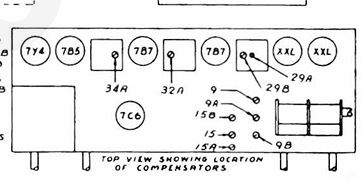
One XXL is the local oscillator, the other one is the mixer. If you have a tube other than an XXL or 7A4 in either of these positions, all bets are off. If you put a 7A7 or 7B7 in the place of an XXL or 7A4, you won't smoke anything but it likely won't oscillate or mix. This configuration of a triode mixer and triode oscillator is rather unique in "modern" (1935 or later) sets. The other unique part is that this set has a 2 stage IF section. This is why some folks comment on how good this set is at "DXing". A pic of the tube layout is below:
The leftmost tube has a shield over it that looks homemade. For the shield to work, it has to be electrically connected to the metal base shell. Yours looks rather corroded. Clean the corrosion off with fine sandpaper unless you think that it is oxidized cadmium (Cadmium is quite toxic). The "LokTail" connects to a contact in the socket that is almost always grounded. You can also clean the tops of the tubes; the printing used for the tube type is quite stable. It's the printing on the side (the brand name) that tends to come off, even with water. I hold the tubes upside down when washing the top of the tube if I don't want to get the sides wet.
I happen to think that Loktal (or Loktail) tubes are of a good design. Yes, the pins are smaller than octal and older tubes, but so are the pins of the 7 and 9 pin miniature tubes. OK,maybe the sockets are an issue but thaqy can be cleaned.
Secondly, yes, touching a long wire to the terminal of the Mixer section of the tuning cap should allow you to tune a station if the oscillator is working. This is the part I meant for Ken's troubleshooting his set, but it could work for you. There are 2 sections to the tuning cap, the mixer / RF and the Oscillator. Usually, the oscillator section is the one closer to the shaft. touch a 25 foot or longer wire to the Mixer section of the cap. Ig you can now receive a signal, then troubleshoot the antenna section of the set. There are antenna coils and the "B" section of the band switch. The "A" Section controls the oscillator.
Hope this helps.
First off, apologies, I may have mixed up your case with Ken Aroyo's 52-942 However, 2 things. First, look at the 2 tubes on the leftmost side of the chassis, behind the tuning capacitor. They should both be 7A4s or XXLs. I can't tell what the first one is, as there is a shield over it. The second one is likely not an XXL. XXLs are triodes which have much smaller diameter plates than Pentodes like 7A7s or 7B7s or Pentagrid Convertors like a 7A8 in the picture, this tube looks like a 7A7.
One XXL is the local oscillator, the other one is the mixer. If you have a tube other than an XXL or 7A4 in either of these positions, all bets are off. If you put a 7A7 or 7B7 in the place of an XXL or 7A4, you won't smoke anything but it likely won't oscillate or mix. This configuration of a triode mixer and triode oscillator is rather unique in "modern" (1935 or later) sets. The other unique part is that this set has a 2 stage IF section. This is why some folks comment on how good this set is at "DXing". A pic of the tube layout is below:
The leftmost tube has a shield over it that looks homemade. For the shield to work, it has to be electrically connected to the metal base shell. Yours looks rather corroded. Clean the corrosion off with fine sandpaper unless you think that it is oxidized cadmium (Cadmium is quite toxic). The "LokTail" connects to a contact in the socket that is almost always grounded. You can also clean the tops of the tubes; the printing used for the tube type is quite stable. It's the printing on the side (the brand name) that tends to come off, even with water. I hold the tubes upside down when washing the top of the tube if I don't want to get the sides wet.
I happen to think that Loktal (or Loktail) tubes are of a good design. Yes, the pins are smaller than octal and older tubes, but so are the pins of the 7 and 9 pin miniature tubes. OK,maybe the sockets are an issue but thaqy can be cleaned.
Secondly, yes, touching a long wire to the terminal of the Mixer section of the tuning cap should allow you to tune a station if the oscillator is working. This is the part I meant for Ken's troubleshooting his set, but it could work for you. There are 2 sections to the tuning cap, the mixer / RF and the Oscillator. Usually, the oscillator section is the one closer to the shaft. touch a 25 foot or longer wire to the Mixer section of the cap. Ig you can now receive a signal, then troubleshoot the antenna section of the set. There are antenna coils and the "B" section of the band switch. The "A" Section controls the oscillator.
Hope this helps.
"Do Justly, love Mercy and walk humbly with your God"- Micah 6:8
"Let us begin to do good"- St. Francis
Best Regards,
MrFixr55