



11-24-2025, 12:36 AM
Good evening, folks:
Work has been pretty busy since I bought the 48-482, but lately I’ve been getting down to business on this restoration. I stripped the finish off the cabinet, and it’s pretty evident that the cabinet has been exposed to water or something that has eaten away the lacquer. I tried using vinegar to lighten the dark spots, and it was somewhat effective but not completely. I also used peroxide. That helped quite a bit, but still not enough. I then started reading about oxalic acid. I’ve given it several liberal coats, really trying to saturate the dark areas, but I still haven’t eliminated those pesky stains on the top piece of veneer. At this point I think I’ll replace that piece of veneer and move on. If anything , I’ve only succeeded in bubbling it loose from the underlying wood. At least the rest of the cabinet is good! Attached is a photo of the dark spots prior to treatment.
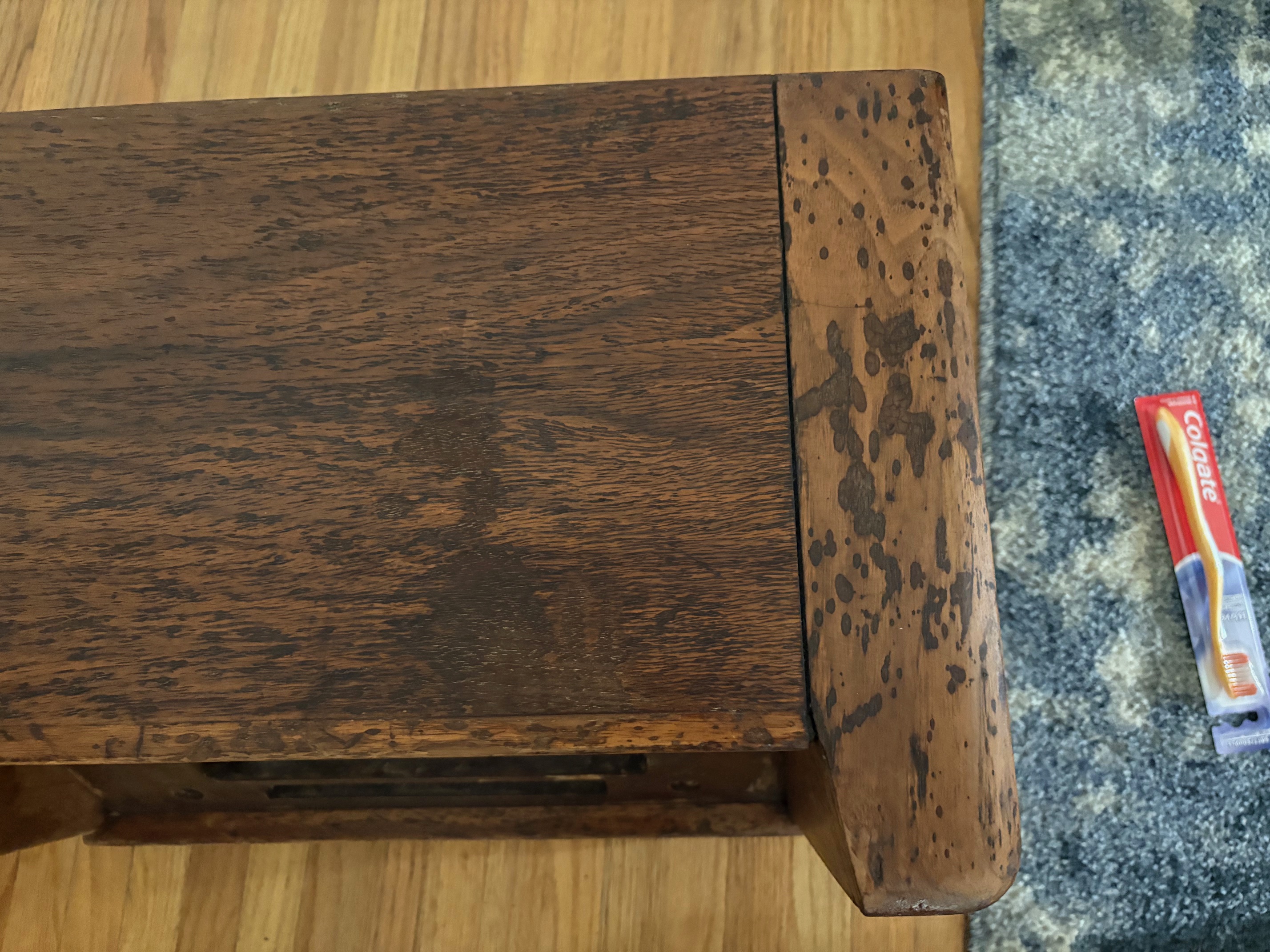
But, I wanted to ask how you all generally use oxalic acid. The stuff I bought says to mix a heaping tablespoon per quart of water, but that hardly did anything. I ended up using a tablespoon per 6oz mason jar. Reading online, though, a lot of people keep pouring in the powder until it stops dissolving. I was tempted to do so, but I’m weary about these unknown chemicals. I made certain to use gloves when mixing it up, but I’ll admit that I didn’t always glove up every time I walked out to reapply another coat. I simply made sure to wash my hands afterward.
I also see different opinions about letting it dry. Some folks say it ruins the wood while others say it doesn’t. I let it dry and then hosed it off very well. I toweled it dry and then dried it a bit more with a blow dryer on low. Then I scoured it with baking soda to help neutralize the oxalic acid. It just seemed like it needed a long time to work, so I felt like letting it soak and dry got the best results. But how do you all normally do it?
Work has been pretty busy since I bought the 48-482, but lately I’ve been getting down to business on this restoration. I stripped the finish off the cabinet, and it’s pretty evident that the cabinet has been exposed to water or something that has eaten away the lacquer. I tried using vinegar to lighten the dark spots, and it was somewhat effective but not completely. I also used peroxide. That helped quite a bit, but still not enough. I then started reading about oxalic acid. I’ve given it several liberal coats, really trying to saturate the dark areas, but I still haven’t eliminated those pesky stains on the top piece of veneer. At this point I think I’ll replace that piece of veneer and move on. If anything , I’ve only succeeded in bubbling it loose from the underlying wood. At least the rest of the cabinet is good! Attached is a photo of the dark spots prior to treatment.
But, I wanted to ask how you all generally use oxalic acid. The stuff I bought says to mix a heaping tablespoon per quart of water, but that hardly did anything. I ended up using a tablespoon per 6oz mason jar. Reading online, though, a lot of people keep pouring in the powder until it stops dissolving. I was tempted to do so, but I’m weary about these unknown chemicals. I made certain to use gloves when mixing it up, but I’ll admit that I didn’t always glove up every time I walked out to reapply another coat. I simply made sure to wash my hands afterward.
I also see different opinions about letting it dry. Some folks say it ruins the wood while others say it doesn’t. I let it dry and then hosed it off very well. I toweled it dry and then dried it a bit more with a blow dryer on low. Then I scoured it with baking soda to help neutralize the oxalic acid. It just seemed like it needed a long time to work, so I felt like letting it soak and dry got the best results. But how do you all normally do it?
Joseph
Philco 39-750 EZ
Philco 46-480
Philco 47-1230
Philco 48-482
Philco 49-906


