



04-30-2026, 03:51 PM
Hey guys,
I have a 49-500 that I am working on. I have the recap done, tubes tested, resistors checked, new power cord, cabinet cleaned/repaired, etc, etc.
But, I have one resistor with some drift and I am unsure if I need to try to replace it.
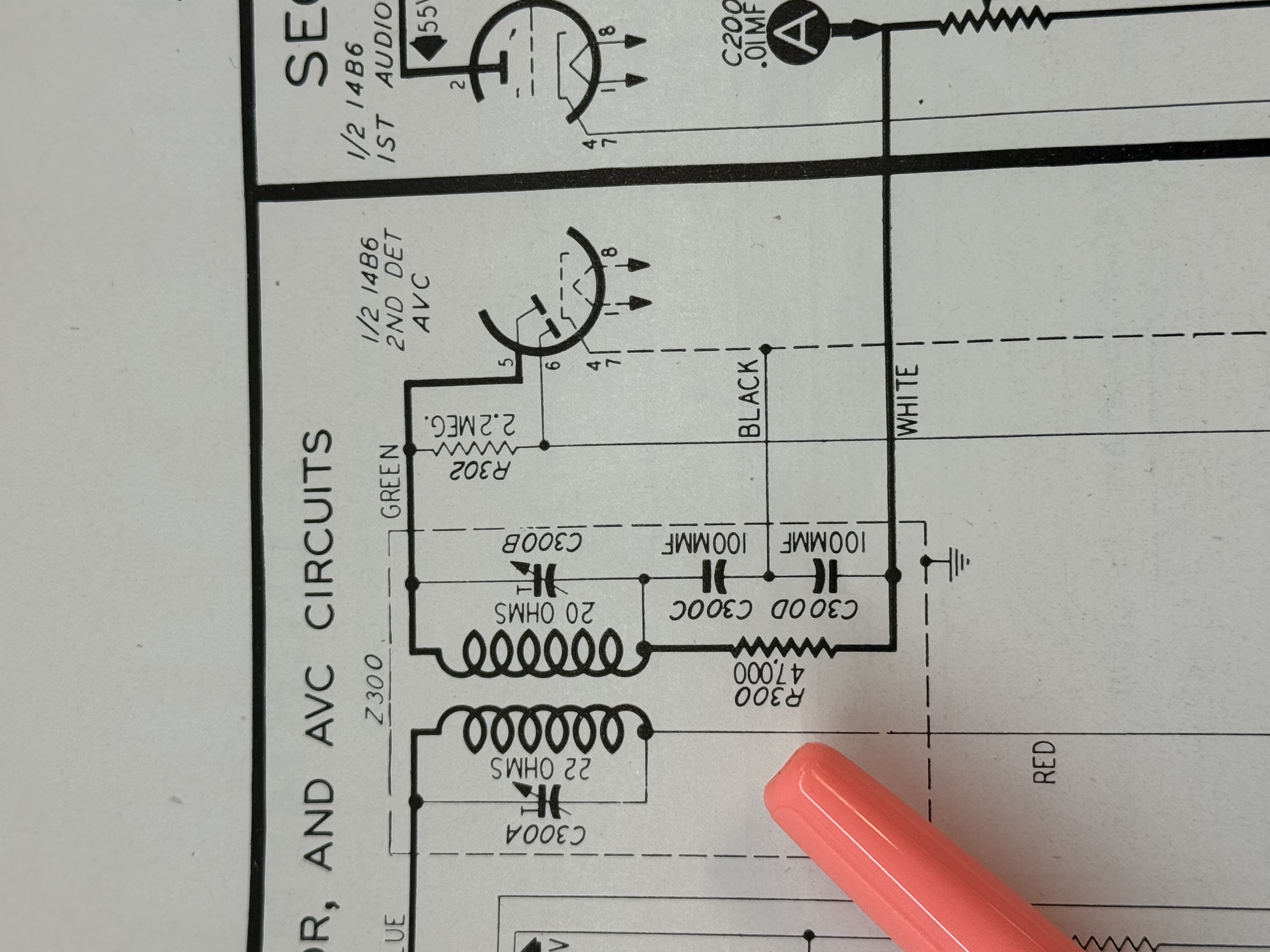
Here is the schematic for reference.
Within the 2nd IF Transformer can is R300, a 47K ohm resistor. When I measure resistance from the green to white wires of the can, I am getting 70.2K Ohm, instead of the expected 47,020 ohms across the secondary of Z300 and R300. Seems that R300 has likely drifted high.
My concern is that a 70k load here is going to mess with the detector diode loading and the AVC, maybe leading to distorted audio or poor gain on stronger stations? Does that seem like a fair concern?
I’m usually reluctant to pull these cans and risk the internal fine-wire connections just to swap a resistor. For those who have restored this chassis:
Thanks for any feedback,
George
I have a 49-500 that I am working on. I have the recap done, tubes tested, resistors checked, new power cord, cabinet cleaned/repaired, etc, etc.
But, I have one resistor with some drift and I am unsure if I need to try to replace it.
Here is the schematic for reference.
Within the 2nd IF Transformer can is R300, a 47K ohm resistor. When I measure resistance from the green to white wires of the can, I am getting 70.2K Ohm, instead of the expected 47,020 ohms across the secondary of Z300 and R300. Seems that R300 has likely drifted high.
My concern is that a 70k load here is going to mess with the detector diode loading and the AVC, maybe leading to distorted audio or poor gain on stronger stations? Does that seem like a fair concern?
I’m usually reluctant to pull these cans and risk the internal fine-wire connections just to swap a resistor. For those who have restored this chassis:
- How critical is that 47k value to the final performance?
- Is it worth the "surgery" to replace it, or have you found that these sets tolerate that much drift in the detector stage?
Thanks for any feedback,
George
Craftsmanship is an ongoing cycle of learning fueled by patience, persistence, and care, where every project refines our judgment and challenges our skills, in the steady pursuit of the Path to Mastery.


