05-17-2026, 12:55 PM
Quote:Well, McIntosh is, after all, AB pushpull.
It uses some techniques to eliminate odd harmonics. Magnetic coupling / bias for crossover elimination, unity gain and pretty deep feedback rarely used in tube amps.
Well, McIntosh is, after all, AB pushpull.
It uses some techniques to eliminate odd harmonics. Magnetic coupling / bias for crossover elimination, unity gain and pretty deep feedback rarely used in tube amps.
Michael, you probably know very well that McIntosh achieved high sound quality precisely with its phenomenal output stages, contrary to the laws of sound physics
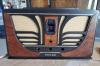
 . Because in general, a push-pull output stage mutually cancels out even harmonics, but doubles the amplitude of odd harmonics, - therefore it is an ideal output stage when using output triodes ( greetings to you from my beloved Philco 37-116
 ), in which odd harmonics end at most at the third harmonic number. But how McIntosh managed to achieve this on the output 6L6G beam tetrodes is a big mystery to me. Well, I understand - a common negative feedback (which always kills the dynamics), cross-connection of the anode of one radio tube and the screen of the second radio tube in the grid pushpool to one half of the output transformer winding (how, how does it work?!), class AB instead of class A (why?!), a few more tricky circuits, but in the end - a masterpiece and an icon for audiophiles!

Here are some spectrograms of triode and pentode small-signal resistive cascades from my database of radio tube characteristics measurements for comparison, to better understand what a huge difference in the harmonic spectrum between triodes and pentodes.
The first screenshot is a spectrogram of a single cascade with a resistor anode load on a 6SN7 triode with a 10-volt amplitude signal at the cascade output. Without any feedback, but according to the operating modes recommended by the manufacturers of radio tubes.
As we can see - the second harmonic is at the level of minus 43 dB. This is approximately 0.8%. Other harmonics are at the level of radio tube noise, about 90 dB.
The second screenshot is a spectrogram of a single stage with a resistor load in the anode on a 6J7G pentode, also with a swing of 10 volts. As we can see - the value of the second harmonic has increased to 32 dB (about 3%), but the third harmonic has already appeared -60 dB (0.1 %) and the fourth -80 dB (0.01%).
In my opinion, this is very indicative.
Old tube radios and gramophones museum TV channel
https://www.youtube.com/user/RadioSvit
Sincerely Peter
З повагою Петро