
08-06-2026, 09:36 AM
Hi Rod,
I agree that the term "ground" may be confusing, and wish that the electronics industry and the antique radio community had some sort of standardization.
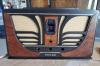
In the case of the radio in this thread and almost all transformer powered sets requiring external antenna and ground connections, the ground connection is the return of the antenna transformer primary, and happens also to be the chassis. Since this is a transformer powered set, the safety of connecting the chassis to an earth ground is not an issue (transformer leakage and the line filter Death Caps notwitstanding).
What I find to be more confusing and potentially dangerous is defining the common return of circuits such as B-, the low side of a series heater string, etc., which is commonly referred to as "ground" but certainly is not. In a warm chassis set, the chassis is not this common connection. In a hot chassis set, the chassis can at a level 120V (in the US) above ground depending on the power switch state and the "polarity" of the power cord. Connecting a "ground" to AC-DC sets must be done with great caution and only to such connection as stated by the manager. Some AC-DC sets had external antenna and ground connections through either a transformer or through a winding on a loop antenna. I have never seen an AC-DC set where an external ground to the chassis was allowed, due to the aforementioned issues.
What Europe refers to as "Earth", the US NEC refers to as "Ground". In radio practice, historically, a ground connection was made to a cold water pipe if available, or to a radiator. The NEC has traditionally required bonding of the service entrance and the "neutral" conductor to the cold water supply to the house at a point very close to that entrance. For a rather long period of time, the NEC also requires a second "made ground" of varyig methods, the most common being a ground rod of at least 8 feet driven into earth material whose composition and moisture are conducive to creating a ground. The NEC has very specific nomenclature for hot, neutral and ground conductors, which I forgot and do not have a document handy. The existence of non-metallic water pipe allowed in recent plumbing codes complicates the issue.
Of course, in automotive electrics, the term "ground" is used to describe using the auto body structure as a common return conductor. (In most US cars built 1956 or later, the "ground" is negative). Of course, where is the "ground" unless your kid tracks dirt in the car or that bag of potting soil that you put in the trunk broke open.
I have tried to use the terms "Return" B- Common or "Mecca" to refer to those points indicated in the schematic of an AC-DC set using the traditional 3 line arrow shaped ground symbol.
"Do Justly, love Mercy and walk humbly with your God"- Micah 6:8
"Let us begin to do good"- St. Francis
Best Regards,
MrFixr55