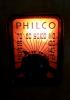
Philco Model 38-7: what caps & resistors do fail typically?
Posts: 16
Threads: 1
Joined: Jun 2025
City: Montreal
State, Province, Country: Quebec
I let the radio run for half an hour... so far no major problem. 70 watts consumption spot on. I'm using a UPS to have a floating supply, this modern stuff gives good waveform and has a power meter! Temperatures are OK, the transformer heats up towards 50° celsius.
On closer inspection I noticed something I've never seen before: a decades-old recapping job!
The red and brown electrolytics around the rectifier tube have been added, the connections to the large can (43) and the smaller one (11A) are both cut. The other cap (11) is still connected, theres a good deal of ripple on it, together with a measurable amount of RF.
With 120 volts on the mains I get 295 volts on B+ with 15 volts RMS ripple. Reception seems quite good, but with full AC voltage the audio starts clipping very early.
Will check the wiring to these two components I mentioned, and the wiring of the power switch. And have a look where to get these caps. Preferably offline.
cheers
Martin
Posts: 1,797
Threads: 55
Joined: Feb 2015
City: Roseville, MN
If I was there with you I would slap your hand with a ruler for running it that long. If one of those filter caps goes you won't have time to cut the power. And there goes 2 or 3 transformers.
AES is having a 15% discount sale on capacitors till the end of the month. I get mine and other parts from Mouser. I buy bulk quantities which reduces unit cost. If you're buying for just one radio it probably won't save you much much. Try to order all or as many from the same vendor to save shipping costs.
(This post was last modified: 06-19-2025, 08:01 PM by RodB.)
Posts: 5,584
Threads: 291
Joined: Nov 2012
City: Wilsonville
State, Province, Country: OR
Vintage electrolytic recapping was often done by simply tacking in some new electrolytics without removing the old electrolytic from the circuit. Bad practice and as Rod said, relying on those old recapped electrolytics is just asking for it to fail. As morzh said, replace all the electrolytics. The old paper caps will also fail if they are not leaky already.
Posts: 16
Threads: 1
Joined: Jun 2025
City: Montreal
State, Province, Country: Quebec
Good Morning,
ayayay... my hands already hurt. 
To my experience these wet electrolytics go open, not short. At least I have never seen a shorted one (except for tantalums, of course). Plus I'm always monitoring temperatures when testing gear. I can use an IR cam here, a formidable troubleshooting tool in general...
These guys are close to my place (biking distance), I'll give it a try once it stopped raining.
cheers
Martin
Posts: 16
Threads: 1
Joined: Jun 2025
City: Montreal
State, Province, Country: Quebec
I made my shopping list, and have a bunch of questions 
- Why is "microfarad" sometimes "mf" and sometimes "mfd"?
- What is a compensator like (7) and (7A) other than a capacitor?
- Component 36 is a resistor (anode supply of 1st audio). Why is the unit "mf", and why such a strange value (99.000 ohms)?
- Component 47, the Y-cap, says ".015-.015, 25mf". Is there a third capacitor of 25uF somewhere?
- All resistors are quite large, even the 1/4 watt types. Any recommondation for the general type of replacement resistor, i.e. 1 Watt carbon film, 2 Watt Metal Oxide?
Voilà the list of capacitors, followed by resistors. On the left what is stated in the manual with the voltage from the actual component, if I could see it. Most of the paper caps are 400 volts, some are 200 volts. On the right what I could get in the shop (radial components if possible), also voltage-wise. Could not find Y-caps on their site...
CAPACITORS
3 .05 mf 50 nF / ?V -> 47nF / 400V
11 4 mfd 4 uF / 350V -> 10uF / 450V
11A 8 mfd 8 uF / 475V -> 10uF / 450V
14 .1 mf 100 nF / 400V -> 100nF / 400V
24 .01 mf 10 nF / 200V -> 10nF / 400V
28 .015 mf 15 nF / 200V -> 22nF / 400V
30 .1 mf 100nF / ?V -> 100nF / 400V
34 .015 mf 15 nF / 400V -> 22nF / 400V
37 .003 mf 3 nF / ?V -> 3,3nF / 400V (not axial)
38 .006 mf 6 nF / 400V -> 6,8nF / 400V (not axial)
40 .008 mf 8 nF / 400V -> 8,2nF / 250V or 7,5nF/1600V (not axial)
45 25 uF 25 uF / 475V -> 33uF / 450V
47 .015 mf 15 nF / Y-cap -> as above, i.e. 22nF 400V?
RESISTORS
12 10.000 ohms (3 watt) -> 10k / 3W
15 1.0 meg (1/4 watt) ->1M / 0,25W
16 10.000 mmf (1 watt) ->10k / 1W
21 490.000 ohms (1/2 watt) ->490k / 0,5W
22 51.000 ohms (1 watt) ->51k / 1W
27 1 meg (1/2 watt) ->1M / 0,5W
31 1 meg (1/2 watt) ->1M / 0,5W
33 1 meg (1/2 watt) ->1M / 0,5W
35 1 meg (1/2 watt) ->1M / 0,5W
36 99.000 mf (1/2 watt) ->100k ?? / 0,5W
Posts: 1,797
Threads: 55
Joined: Feb 2015
City: Roseville, MN
Microfarad is uf, mfd, mf and possibly more. You'll have to use your imagination. The 99,000 mf is a misprint. It's 99k ohms and you can use 100k. Try getting 4.7mfd for the 4mfd. Value for Y caps can be 0.01mfd. Resistor wattage is whatever the parts list says but you can use half watt for quarter watt.
Posts: 16
Threads: 1
Joined: Jun 2025
City: Montreal
State, Province, Country: Quebec
I managed to buy the required capacitors at a store that has thousands of bins, you can pick your items yourself, one by one, then pay in cash... Nice!
That took some time, it was late afternoon and the shop closed before I could choose my resistors. Have to wait until Monday.
The recapping job looks quite odd with all those radials, but no choice. Did start with the electrolytics, one at a time, to see what improvements I get. Nothing spectacular but considerably less ripple on the scope.
Even with all electrolytics swapped I had a lot of hum between stations, disappearing on stronger ones or when the volume is turned down. Probing of the audio output revealed spikes with 120Hz repetition rate. Maybe RF from the cheapo UPS, either by air or through the power cord? With the mains directly plugged in the wall (and not in the UPS), hum between stations totally disappeared.
The overall sound quality has improved somewhat, did not check the audio section yet. When selecting a station some hum comes up. Not on all stations. Any idea where that could come from?
Cheers
Martin
Posts: 16
Threads: 1
Joined: Jun 2025
City: Montreal
State, Province, Country: Quebec
Quote:Resistor wattage is whatever the parts list says but you can use half watt for quarter watt.
Actually I was wondering what wattage gives about the same size as the smallest resistors in the unit - which are quite large. The websites I checked do not give these dimensions, but since I will buy offline I can check with my own eyes.
Should I rather take carbon film as originally used, or some improved type like metal oxide?
cheers
Martin
Posts: 1,797
Threads: 55
Joined: Feb 2015
City: Roseville, MN
I usually buy whatever is cheapest, which is most likely carbon composition. Some people have issues with one over the other but I've never had any problems. Like I said use the schematic and parts list as your guide. If the original resistors are dog bone then they will be much larger than their modern replacements. The main location where wattage is more critical is where there's current flowing; plate, cathode and power supply circuits. I have 3 watt resistors that are about the same size as half watt dog bones.
Posts: 3,186
Threads: 226
Joined: May 2008
City: Omak
State, Province, Country: WA
Hello Martin,
Far as the resister size the newer parts are designed and use better materials so that is why they are so much smaller .
That is really cool that you could walk into a store to buy your parts !
Sincerely Richard
P.S. my Dream store would beable to walk into a Mouser or Allied Store .
Posts: 16
Threads: 1
Joined: Jun 2025
City: Montreal
State, Province, Country: Quebec
Cleaned the chassis, tubes, sockets... switches not yet. Seems to have improved things a little bit, but maybe imagination.
The hum that comes up when tuning in a station only appears in the middle of the scale, not at the ends. Band-switch is in the CCW position. Position n°1 (Broadcast) according to the diagram, if I'm right.
Something else: how can I change the light bulb? I unscrewed the ring in front, took out the glass, but do not see an easy way to get to the bulb.
cheers
Martin
Posts: 16
Threads: 1
Joined: Jun 2025
City: Montreal
State, Province, Country: Quebec
Quote:On those two parts you pointed out earlier, I can't tell what they are. Perhaps you can tell us where the wires on them are connected in the circuitry.
The disc-like item is connected between chassis ground and pin A4 on the rotary switch (48).
The white block is connected between chassis ground and pin A4, too...
So both are parallel to capacitor (8), a 3.5nF mica type which is there where it is supposed to be.
Any idea what these two components are good for? See the pics in my previous post.
cheers
Martin
Posts: 1,797
Threads: 55
Joined: Feb 2015
City: Roseville, MN
They are connected in the oscillator circuit and they are add-on devices. Perhaps some sort of oscillator stability device. The disc looks like it might be a ceramic capacitor or battery. Is the other a plastic container? It might be a coil. If you have one of those component testers try testing them. Otherwise I'm stumped. Parasites.
Posts: 16
Threads: 1
Joined: Jun 2025
City: Montreal
State, Province, Country: Quebec
Its plastic, I'm quite sure. I don't have a component tester, unfortunately.
There are some videos on youtube about restoration of the 38-7, these 2 components are present but never talked about.
Posts: 1,797
Threads: 55
Joined: Feb 2015
City: Roseville, MN
Before I forget entirely, compensators are the old term for trimmer capacitors. Hence they compensate for the total +- tolerance of circuitry components.
Users browsing this thread: 3 Guest(s)
|
|
Recent Posts
|
|
Philco P45-6365 Universal Transformer Instruction Manual
|
| Can anyone guide me to where this may be found?GRG — 03:00 PM |
|
54C Complete Teardown/Rebuild
|
| I don't think that I have encountered a 12Z3 before, curious how it uses one of those but includes a #43, which is a 25 ...Arran — 02:17 PM |
|
HiFi (Chifi) tube amp build - but my own design.
|
| It's the other forum. I'm also in DIY, but mostly read there. Honestly, I kinda jumped into this without much thought to...TV MAN — 10:43 AM |
|
Philco 71 Code 125
|
| Hello,
I am in need of a schematic for this radio. Mine has the three separate circular tube shields and a shadow me...dconant — 08:06 AM |
|
Stromberg Carlson 1500 Squeal
|
| And life just keeps getting more complicated.dconant — 07:57 AM |
|
54C Complete Teardown/Rebuild
|
| Hello Roy,
here is this one
sincerely Richardradiorich — 12:45 AM |
|
54C Complete Teardown/Rebuild
|
| Richard,
Had grabbed it already but thank you just the same. I find myself wanting to find some way to block out the...glyphmon — 12:03 AM |
|
54C Complete Teardown/Rebuild
|
| Hello roy,
here is a link to the schematic .
Sincerely Richardradiorich — 11:54 PM |
|
54C Complete Teardown/Rebuild
|
| Richard,
The Silvertone 2014 also is a transformerless set, so I am incorporating a 1:1 600 ohm audio isolation transfo...glyphmon — 11:37 PM |
|
Preliminary work on wife's Silvertone 2014
|
| Did an alignment today which was interesting. IF alignment went great, almost all was already spot-on. Adjusting on th...glyphmon — 11:35 PM |
|
Who's Online
|
There are currently 1791 online users. [Complete List]
» 2 Member(s) | 1789 Guest(s)
|
|
|

|
 
|