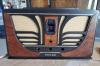
I am replacing a philco 32-7981 audio output transformer with an open primary in a 41-315X. I have read in this thread, https://www.philcoradio.com/phorum/showt...p?tid=9968 , that a Hammond HX-125D is a possible replacement.
The post goes on to say "Edit: You won't find a new transformer that has the feedback tap in the secondary which the original had. But that can be worked around; we can tell you how when you get your new transformer."
I never did see the work around for the feedback tap.
Can anyone explain please?
Glenn
(This post was last modified: 09-14-2025, 07:55 AM by GRG.)
This reminds me of the German radios from the late 50s early 60s I have restored. The Germans perfected the r-c negative feedback in every set they produced. If you look up the schematic for a Grundig 3198 or any model in that number range you'll see what I mean. You'll even find their warnings that if the opt is replaced the secondary wire connected to the feedback network must be the correct phase as was pointed out in the link above. But it works fine and it's a simple application.
Measure from the leg that is grounded to the feedback tap.
Divide this resistance by the full resistance to get a ratio of tap resistance/full resistance. These resistance
values will be quite low but hopefully the meter sensitivity and resolution is good enough to give you an
accurate ratio.
Duplicate the ratio with two 1 Watt resistors with the larger one being 100 Ohms. Put the 2 resistors in series
with each other and this pair of resistors in parallel, with the output transformer, with the "leg" of the lower resistance value on the
grounded end of the transformer and the leg of the higher resistance value to the other connection to the loudspeaker. The junction of
the 2 resistors is the feedback tap.
Hope this helps.
"Do Justly, love Mercy and walk humbly with your God"- Micah 6:8
"Let us begin to do good"- St. Francis
I was able to get a Canadian made NOS Hammond 125D new in box for $25 CDN!
Per Ron's comments in forum post https://philcoradio.com/phorum/showthrea...edback+tap I used the attached schematic for the 46-1209 feedback replacement. I started by using a 4.7 ohm (R201) and 68 ohm (R202) as per the 46-1209 schematic and found a sharp squeal at low volume. Then I used an 82 ohm for the R202 and it worked great. For fun I moved the R202 up to 100 ohms but the sqeal came back. Returned to the 82 ohm and I am quite happy.
Thanks everyone who chimed in on this and a special thank you for Ron.
Glenn
(This post was last modified: 09-18-2025, 07:01 AM by GRG.)
$25 Canadian for an output transformer? Go to confession; that was a steal!!
As to "Mr Fixr had some good advice", even dead clock is correct twice in a day.
The interesting thing is that this does not appear to be negative feedback, it appears to be positive feedback. I may be wrong counting stages and figuring whether the feedback is negative or positive. I am used to seeing feedback being put into the cathode of a first audio stage. I will have to dig up some old Heathkit HiFi schematics. It is not common to find feedback circuits in "popularly priced" radios, but people were also not used to finding technology like the "Beam of Light" phono pickup that Philco used in the early 1940s or the GE RPX magnetic cartridge that came later which was the basis for modern magnetic pickups. These distort much less than crystal or ceramic pickups.
As always, I urge you to add an aux or phono input if one does not exist. Inputting programming from a computer (Lots of old time radio programs out there on the internet), MP3, CD plyer, etc., will make this set ROCK. I had a friend who used to input his guitar into the set for a mellow jazz guitar effect. Not loud because there was not enough gain but a nice sound.
"Do Justly, love Mercy and walk humbly with your God"- Micah 6:8
"Let us begin to do good"- St. Francis