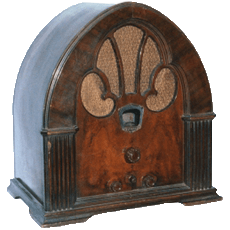
Philco 40-180 Transformer Question
Posts: 35
Threads: 3
Joined: Apr 2026
City: Andover
State, Province, Country: MN
Hey everyone - totally new here so hope I'm posting in the right place.
Never restored a radio before but do have an electrical engineering background (though it's been a number of years since I've done bench work).
After reading a variety posts and watching videos on Youtube, I began testing my Philco 40-180 radio using a Dim Bulb Tester. The bulb lit up strong, so problem somewhere. I started trying to go about isolating the transformer bit by bit. Each time it lit up strong as ever.
I had measured the impedance across the primary, secondary etc. and the impedance when off is okay-ish in the various windings (e.g. instead of 7ohm in the primary that the schematic says, I was getting about 13).
Eventually, I disconnected everything from the transformer and ran only across the primary and the bulb stayed as bright as ever. So thinking that once AC is applied, I've got transformer issues and it needs to be replaced.
Is this the right assessment? Appreciate any diagnostic steps I should be taking here. Seems like finding a replacement for this could be difficult so I want to make sure I've confirmed a transformer problem before I try to find a replacement.
Appreciate any and all guidance !
Thanks!
Posts: 18,427
Threads: 622
Joined: Oct 2011
City: Jackson
State, Province, Country: NJ
OK.
1. Welcome. 40-180 is not teh champion but will sound well enough once done.
2. I recently made a point of skipping reading results immediately after seeing someone plugged an unrecapped radio in, coupled with dim bulb tester and proceeding right to the end. The first is a bad thing to do, the second is ... I would compare it with using some dry raspberries to drop thefever and observe, after the antibiotics became available.
So.
1. Ditch the youtube. Go to a forum (OK, you have just done it), read the "101" and ask questions.
2. What you measured was NOT an impedance. It was DC resistance (as one EE to another). There's a difference, and DC resistance in transformers and chokes, while somewhat informative, is not necessarily what you want to know.
3. If you are bent on using that dimwit tester (this is what I call them) and you do not have a variac and agood DMM, here's what you could do.
- Make sure you are absolutely sure BOTH the secondary windings are disconnected. The rectifier tube is removed.
Also, the filament winding goes to Chassis; disconnect it also (unsolder). "cause, you know, you never know.
- Then measure the DC resistance across your power plug, it should be tens or a couple of hundreds of Ohms. NOT a short.
- If shorted, make sure it is not your power cord/power plug, and it is not cracked/shorted.
- Make sure your power switch is still a switch.
- In case switch/cord are bad, cut off and use wires.
- Then connect that dimwit lighbulb thing in series with the power wires, plug into AC (make sure you can pull the plug very quickly...in case of any eventuality) and see if the bulb is bright. If it is, your transformer is a gonner. If not, start the restoration.
A 40-180 with a bad transformer, to me, is not worth the effort spent.
I am sure there will be some different opinions.
People who do not drink, do not smoke, do not eat red meat will one day feel really stupid lying there and dying from nothing.
Posts: 35
Threads: 3
Joined: Apr 2026
City: Andover
State, Province, Country: MN
Thanks for the detailed reply, very helpful!
Posts: 1,797
Threads: 55
Joined: Feb 2015
City: Roseville, MN
You've done enough to indicate a problem with the transformer. With no load it should not light the bulb. If you test for shorts between windings or the iron core it may indicate where the problem is. Another thing is to see if the transformer gets warm quickly. I checked my 40-180 parts box and found a power transformer that checked OK on the ohmmeter. Later today I can apply power, send you a photo and if you post a wanted ad in the Phorum I can make arrangements.
Mike, if the part is available, why not fix it. He would get the experience at the least.
(This post was last modified: 04-12-2026, 12:38 PM by RodB.)
Posts: 35
Threads: 3
Joined: Apr 2026
City: Andover
State, Province, Country: MN
Posts: 18,427
Threads: 622
Joined: Oct 2011
City: Jackson
State, Province, Country: NJ
If the resolve is there, sure.
On one hand, 40-180 is not exactly very popular. It was the starter of that series.
On the otehr hand, yes, 1940 line has at least one advantage: the bezel is brass, not tenite, and so could be in good shape. Plus replicated buttoms and such are available from RadioDaze.
Also, a radio could be a family heirloom or has some history that makes it worthy.
And then, of course, any radio that is not a total junk (which happens; this is why we have that bonfire pit in Kutztown, and lite it twice a year) deserves a home.
As for the transformer, especially tested with dim bulb, it's being dead requires proof before it is tossed; this is why I suggested that sequence of actions. To make sure the patient is rather dead than alive.
People who do not drink, do not smoke, do not eat red meat will one day feel really stupid lying there and dying from nothing.
Posts: 35
Threads: 3
Joined: Apr 2026
City: Andover
State, Province, Country: MN
Just for more details, the first thing I did was to replace the nasty cracked power cord and added an inline fuse. That all tested fine as did the switch.
I removed every connection from the transformer except for the two power lines as you suggest and still fail the dim bulb test.
Rod, if you do have a replacement, I'd be interested and posted in the want ad forum. I also happen to live in Minnesota not far from you.
Thanks to you both for the expertise.
(This post was last modified: 04-12-2026, 03:18 PM by tfonzart.)
Posts: 18,427
Threads: 622
Joined: Oct 2011
City: Jackson
State, Province, Country: NJ
Well, you are lucky, Rod is a neighbor and has a transformer.
Good!
People who do not drink, do not smoke, do not eat red meat will one day feel really stupid lying there and dying from nothing.
Posts: 35
Threads: 3
Joined: Apr 2026
City: Andover
State, Province, Country: MN
Agree!
Thanks again for the help!
Posts: 1,797
Threads: 55
Joined: Feb 2015
City: Roseville, MN
Maybe you could hit the casino on the way home.
Maybe after the transformer Install.
Posts: 35
Threads: 3
Joined: Apr 2026
City: Andover
State, Province, Country: MN
Posts: 431
Threads: 9
Joined: Apr 2023
City: Roanoke
State, Province, Country: Virginia
tfonzart Wrote: I had measured the impedance across the primary, secondary etc. ...
You did not measure the impedance - you measured the resistance.
Dale H. Cook, GR/HP/Tek Collector, Roanoke/Lynchburg, VA
https://plymouthcolony.net/starcity/radios/
Posts: 35
Threads: 3
Joined: Apr 2026
City: Andover
State, Province, Country: MN
Apologies for my misuse of impedance vs resistance. I appreciate the correction!
Posts: 431
Threads: 9
Joined: Apr 2023
City: Roanoke
State, Province, Country: Virginia
I notice things like that, because I am equipped to measure impedances (or in some bands, admittances) from 20 Hz to 20 kHz, and from 400 kHz to 1.5 GHz.
Dale H. Cook, GR/HP/Tek Collector, Roanoke/Lynchburg, VA
https://plymouthcolony.net/starcity/radios/
Posts: 18,427
Threads: 622
Joined: Oct 2011
City: Jackson
State, Province, Country: NJ
Rod,
I was about to suggest he same (though my choice was Powerball).
People who do not drink, do not smoke, do not eat red meat will one day feel really stupid lying there and dying from nothing.
Users browsing this thread: 1 Guest(s)
|
|
Recent Posts
|
|
Philco P45-6365 Universal Transformer Instruction Manual
|
| Can anyone guide me to where this may be found?GRG — 03:00 PM |
|
54C Complete Teardown/Rebuild
|
| I don't think that I have encountered a 12Z3 before, curious how it uses one of those but includes a #43, which is a 25 ...Arran — 02:17 PM |
|
HiFi (Chifi) tube amp build - but my own design.
|
| It's the other forum. I'm also in DIY, but mostly read there. Honestly, I kinda jumped into this without much thought to...TV MAN — 10:43 AM |
|
Philco 71 Code 125
|
| Hello,
I am in need of a schematic for this radio. Mine has the three separate circular tube shields and a shadow me...dconant — 08:06 AM |
|
Stromberg Carlson 1500 Squeal
|
| And life just keeps getting more complicated.dconant — 07:57 AM |
|
54C Complete Teardown/Rebuild
|
| Hello Roy,
here is this one
sincerely Richardradiorich — 12:45 AM |
|
54C Complete Teardown/Rebuild
|
| Richard,
Had grabbed it already but thank you just the same. I find myself wanting to find some way to block out the...glyphmon — 12:03 AM |
|
54C Complete Teardown/Rebuild
|
| Hello roy,
here is a link to the schematic .
Sincerely Richardradiorich — 11:54 PM |
|
54C Complete Teardown/Rebuild
|
| Richard,
The Silvertone 2014 also is a transformerless set, so I am incorporating a 1:1 600 ohm audio isolation transfo...glyphmon — 11:37 PM |
|
Preliminary work on wife's Silvertone 2014
|
| Did an alignment today which was interesting. IF alignment went great, almost all was already spot-on. Adjusting on th...glyphmon — 11:35 PM |
|
Who's Online
|
There are currently 1837 online users. [Complete List]
» 2 Member(s) | 1835 Guest(s)
|
|
|

|
 
|