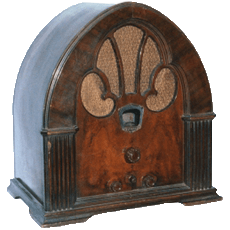
Farm Model - Battery Eliminator?
Posts: 109
Threads: 15
Joined: Mar 2024
City: BERTHOUD
State, Province, Country: CO
Hey all,
I have a Philco and Zenith farm model units coming up on my restoration list. Wondering if anyone has experience with one of these battery eliminator options, or some other recommendation? Ideally it would be nice to have one that could be left in the unit permanently but could also be an option to buy one unit and just use it to power any farm model unit that I work on. Thoughts and ideas?
Options I researched:
1. Retro Radio Shop battery eliminator
2. Big River Hardware universal battery eliminator
3. Antique Radios ARBE-III battery eliminator
Craftsmanship is an ongoing cycle of learning fueled by patience, persistence, and care, where every project refines our judgment and challenges our skills, in the steady pursuit of the Path to Mastery.
(This post was last modified: 04-23-2026, 08:50 PM by SRv2.)
Posts: 1,419
Threads: 41
Joined: Jan 2014
City: Wellborn Florida
Posts: 1,797
Threads: 55
Joined: Feb 2015
City: Roseville, MN
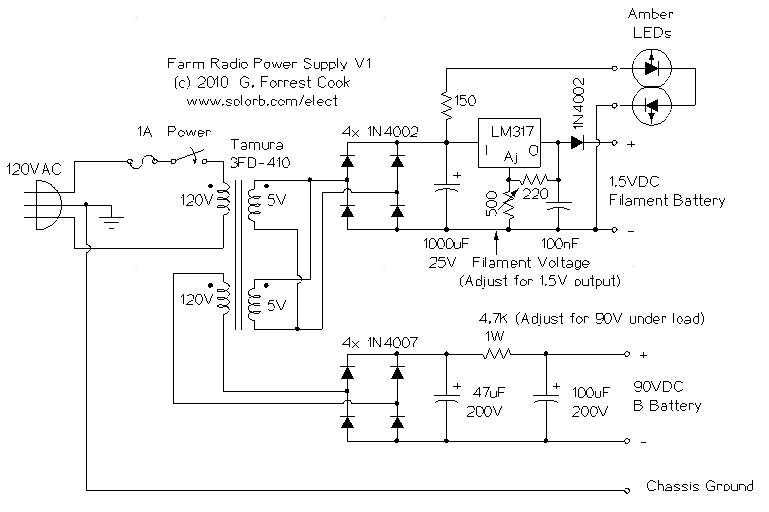
Here's the one I build. I get the transformer from Mouser 553-FS10-600-C2.
Posts: 109
Threads: 15
Joined: Mar 2024
City: BERTHOUD
State, Province, Country: CO
Thanks David and Rod. I’ll have to think if I want to build one or try purchasing one of the units I linked to. Great info, thank you both. George
Craftsmanship is an ongoing cycle of learning fueled by patience, persistence, and care, where every project refines our judgment and challenges our skills, in the steady pursuit of the Path to Mastery.
Posts: 109
Threads: 15
Joined: Mar 2024
City: BERTHOUD
State, Province, Country: CO
I noticed when Mike was demonstrating Ron’s AK10-A in his video (which was great to see btw), he is using the ARBE-III unit https://www.arbeiii.com/
I may purchase one of these for my bench testing of farm radios. Seems like a good unit. George
Craftsmanship is an ongoing cycle of learning fueled by patience, persistence, and care, where every project refines our judgment and challenges our skills, in the steady pursuit of the Path to Mastery.
Posts: 18,427
Threads: 622
Joined: Oct 2011
City: Jackson
State, Province, Country: NJ
The third link is the same as the second; not ARBE III.
This said, ARBE is made very well, kinda like a Cadillac version.
I am sure all of them will work.
People who do not drink, do not smoke, do not eat red meat will one day feel really stupid lying there and dying from nothing.
Posts: 109
Threads: 15
Joined: Mar 2024
City: BERTHOUD
State, Province, Country: CO
Thanks Mike,
I fixed the third link in my original post for any future reference. Appreciate the feedback on the ARBE III.
George
Craftsmanship is an ongoing cycle of learning fueled by patience, persistence, and care, where every project refines our judgment and challenges our skills, in the steady pursuit of the Path to Mastery.
(This post was last modified: 04-23-2026, 10:09 PM by SRv2.)
Posts: 5,652
Threads: 56
Joined: Sep 2008
City: Sandwick, BC, CA
In my opinion the ARBE III is complete overkill for a 1940s era farm battery set, those only have two voltages required, 1.5 volts for the "A", and 90 volts for the "B", I don't think I have seen one that required a "C" battery. With 1930s farm sets it's a little more complicated, those usually require at least three voltages, 2 volts for the "A" (three if connected in Air Cell mode", 90 volts for "B+" and 135 volts for "B++". Some require a "C" battery, which is really for bias in the power output stage, most of those are -4.5 volts, you can build a supply for that, but since there is no load on the bias battery you can just use actual batteries, and they will last for their shelf life.
1920s battery radios are paradoxically simple, which is why they require a more complex power supply, for whatever reason they had not clued into the idea that they could build a voltage divider into the radio rather then using three or more B+ voltages. But then again the 1920s was deluged by constant patent wars, where the ones making the big profits were the lawyers, so a lot of engineering decisions were made on the basing of evading royalty payments.
Regards
Arran
Posts: 18,427
Threads: 622
Joined: Oct 2011
City: Jackson
State, Province, Country: NJ
Arran
>>ARBE III is complete overkill for a 1940s era farm battery set
So it might be, however often times the power supply like this one is bought to rotate between radios. Otherwise you have to buy one for eachset/group of sets, and should you have more than 3-4 different types (OK, AK10 and that 1940s set), you now have to buy at least two. At $150-200 a pop that gets costly.
And the rest of those in these links above, they are comparable to ARBE price-wise. While having less convenient connections.
I also believe, from the pictures, the middle one is DCDC switcher (or it looks like it). Which might be just fine, depends on who made it and how.
People who do not drink, do not smoke, do not eat red meat will one day feel really stupid lying there and dying from nothing.
Posts: 2,327
Threads: 23
Joined: Jul 2020
City: Greenlawn
State, Province, Country: NY
Hi SRv2,
What you need depends on the type of farm set. There were many different versions including the following:
2V A (filament), 90V or 135V B, -3, -7,5V C for many farm sets from about 1932-1938
1.5V A, 90V B some farm sets from mid 1938 on, many battery only portables
6VDC (Set used a vibrator power supply for B+, tube heaters and the vibrator power supply ran off 6VDC from a storage battery, much like a car radio). Common on farms that were mechanized or had windmills (Win-Charger)
32VDC (series filament string, and space charge tubes that could run off 32VDC without a vibrator power supply. These were used on farms that had a 32V power plant and bank of storage batteries.
If the set uses 1.5V for A and 90V for B, consider using a D Cell for the A battery and the circuit from Phil's Old radios for a B supply. However, use an isolation transformer with that supply. The supply that Rod B built is excellent and is likely much cheaper to build than buying an ARBE
The ARBEIII is expensive but could run the first 2 types easily. I have one and love it, but I use it for the old 1920s sets that use 01As, 112s, 71s, etc. Of the 3 commercially built supplies that you researched, the ARBE is head and shoulders above the others, especially considering the price of the others. At $140, I wouldn't even consider the BEAR.
For my RCA 5BT and 6BT (2V, 135V, -3, -7.5V, I built a 135V supply for about $50. For the 2V filaments, I used a 3V 1A wall wart and a 2 Ohm 5 W resistor (the set needed 2V at 500 mA for the heaters).
Hope this helps.
"Do Justly, love Mercy and walk humbly with your God"- Micah 6:8
"Let us begin to do good"- St. Francis
Best Regards,
MrFixr55
Posts: 5,652
Threads: 56
Joined: Sep 2008
City: Sandwick, BC, CA
Mike;
For 1940s battery sets the one Rob showed is probably the best bet, if one can assemble the parts himself, even the transformers are not that expensive, and everything is available from Mouser, where you can pick and choose the quality of the parts you wish to use for under $50. Other then the ARBE III I know nothing about the other two, especially by reputation, and the vendors are not volunteering much. The middle offering looks like it's using mystery brand caps from "The Middle Kingdom", I can't tell what it has for transformers, whether they are operating from the mains or if it's switcher junk. The BEAR one looks very cheap and cheerful, like a glorified power supply from a laptop, that may be unfair but I would like to know what circuitry is used in even a $145 supply.
I have a power supply that will operate just about any tube battery radio, except for a 6 volt set, it's a vintage battery eliminator that was restored, and modernized, but I seldom use it because it's larger then some of the farm battery sets I've operated from it. This was why I acquired two of the Electro brand ones, they were designed to operate battery only tube portables from AC and will fit in the battery compartment of many vintage portables. However only the "A" side is isolated from the power line, the "B" side is basically like that of an AC/DC set, so you can't connect a ground to the ground terminal of your farm set.
A late friend of mine actually electrified a 1940s battery set using an isolation transformer from a razor outlet, he managed to find one that had a gap between the core, and the outside iron such that he could add an extra winding for the "A" supply. He used an LM317 voltage regulator to clean up the ripple, hiding the regulator, diodes, caps, etc., under the chassis, however he regrated doing it because even though it wasn't noticeable it's a heavy modification for a vintage radio. I've saved a few of those razor transformers for building an "off board" supply, though I think I will use a transformer from an old "wall wart" or transistor radio for the "A" supply
Regards
Arran
(This post was last modified: 04-26-2026, 01:35 AM by Arran.)
Posts: 3,186
Threads: 226
Joined: May 2008
City: Omak
State, Province, Country: WA
Hello rob,
that looks like a good design easy to build !
Sincerely Richard
Posts: 5,652
Threads: 56
Joined: Sep 2008
City: Sandwick, BC, CA
Here is a thread on the ARF about building battery eliminators for 1940s farm radios https://antiqueradios.com/forums/viewtop...9&t=199768
Regards
Arran
Posts: 2,327
Threads: 23
Joined: Jul 2020
City: Greenlawn
State, Province, Country: NY
The above ARF link makes for very good reading. A few interesting takeaways:
One contributor added 3 diodes in series across the filament output, anodes to positive, cathodes to negative. This is a great idea as it acts as a "clamp" to protect the rather valuable 1.4V tubes from burnout in case of regulator shorting or other failure that causes an overvoltage. While the octal 1.4V tubes are not as rare as UV199s or the dreaded WD11, the original Sylvania design "G" taller skinnier tubes (small shell octal, T9 envelope, about 3 7/8" length) are more scarce than the newer style with the medium or wafer octal base, which will not clear the shield mounting in some sets.
A 4 tube 1.4V / 90V farm or portable radio draws 250 mA. A standard alkaline D cell has a capacity of about 12,000mA Hours to discharge. Therefore one D cell can run the filaments of the radio for about 40 - 50 hours. This simplifies design so that you need only a "B" supply.
Building the B Supply should be very easy. The circuit from Philip Nelson's "Phil's Old Radios" in the following link from David:
https://antiqueradio.org/bsupply.htm
would cost less than $15.00 for the handful of parts and perfboard to build. Any transformer that you can scrounge that has 2 separate primary windings for 120/240V can be used as an isolation transformer for safety. Even if you have 2 decent size transformers that are 120 V primary and secondary voltages that match, you can connect the secondaries of the 2 transformers together and Voila! you have an isolation transformer
Another contributor had recommended using a "nixie tube power supply" for the 90V. There are many of these kits of Chinese origins from eBay for very little money. However, I have tried this myself, with extra filtering both with electrolytics and mylar caps (as electrolytics don't filter high frequency very well. The experiment was an epic failure. Much noise. I was hoping that it would work because I wanted to make the radio portable by powering from 8 AA cells for 12V to run the nixie supply.
I remember someone here at the Phorum discussing powering tube radios from the "portable" 120V AC supplies, such as the one from Jackery. He stated that his Jackery supply ran the AA5 set cleanly where other cheaper brands do not. I have one of the cheaper portable supplies with a "modified sine wave" output (the Jackery supposedly has true sine wave output), and interestingly enough, when powering a Philco Transitone AA5 with this, there was much noise but when using the same supply on a transformer powered radio with a full wave rectifier, the result was clean sound (and this was on AM, with a wire antenna instead of a loopstick. Therefore, I think that full wave rectification of the output of a switcher may be part of the solution. However, in almost any switcher that I have looked at, the output of the transformer is rectified using half wave rectification.
Vibrator power supplies as used in auto radios are old school examples of "switching" power supplies. However, I believe that almost all auto radios of the era that used vibrator power supplies used a full wave rectifier or were "synchronous (Secondary winding switched in synchronization with the primary winding, yielding DC).
I have used a recycled computer power supply for 5V for filaments very successfully. I have used a 3V Wall Wart supply with resistance in series for Farm sets using 2V tubes, also successfully. This is interesting that switchers don't cause noise when heating filaments (or solid state electronics for that manner; they are widely used in modern audio).
Sorry, this turned out to be long, but these are my "brain droppings" (Sorry Mr. Carlin).
"Do Justly, love Mercy and walk humbly with your God"- Micah 6:8
"Let us begin to do good"- St. Francis
Best Regards,
MrFixr55
Posts: 109
Threads: 15
Joined: Mar 2024
City: BERTHOUD
State, Province, Country: CO
Thanks to everyone for the great feedback and input. I'll read over the ARF forum link and study all of this. I have 2 maybe 3 farm sets, one Zenith and one or two Philco units. When I went into pre-retirement 2 years ago, I also went into panic mode unsure what the heck I was going to do with my time. I went on a buying spree on eBay of radios to fuel my fire, and as my wife kindly notes, I may have gone just a tad overboard. Before I realized it, I had purchased a couple/few farm sets because I liked the cabinets and wanted to restore them, without realizing the challenge of powering them. I'd like to build something that could be placed inside each radio and permanently left to power it off AC, so most likely will investigate building Rod’s design in a project box. Otherwise, possibly purchase an ARBE III to at least work on the chassis and power it and then have the ARBE for my future use. I'll pull down both models off my upper cabinet display and get the model numbers and look up input voltage requirements from the schematics. The information provided by this group is invaluable, thank you all very much for taking the time, enjoy your Sunday.
George
Craftsmanship is an ongoing cycle of learning fueled by patience, persistence, and care, where every project refines our judgment and challenges our skills, in the steady pursuit of the Path to Mastery.
(This post was last modified: 04-26-2026, 10:11 AM by SRv2.)
Users browsing this thread: 1 Guest(s)
|
|
Recent Posts
|
|
Philco P45-6365 Universal Transformer Instruction Manual
|
| Can anyone guide me to where this may be found?GRG — 03:00 PM |
|
54C Complete Teardown/Rebuild
|
| I don't think that I have encountered a 12Z3 before, curious how it uses one of those but includes a #43, which is a 25 ...Arran — 02:17 PM |
|
HiFi (Chifi) tube amp build - but my own design.
|
| It's the other forum. I'm also in DIY, but mostly read there. Honestly, I kinda jumped into this without much thought to...TV MAN — 10:43 AM |
|
Philco 71 Code 125
|
| Hello,
I am in need of a schematic for this radio. Mine has the three separate circular tube shields and a shadow me...dconant — 08:06 AM |
|
Stromberg Carlson 1500 Squeal
|
| And life just keeps getting more complicated.dconant — 07:57 AM |
|
54C Complete Teardown/Rebuild
|
| Hello Roy,
here is this one
sincerely Richardradiorich — 12:45 AM |
|
54C Complete Teardown/Rebuild
|
| Richard,
Had grabbed it already but thank you just the same. I find myself wanting to find some way to block out the...glyphmon — 12:03 AM |
|
54C Complete Teardown/Rebuild
|
| Hello roy,
here is a link to the schematic .
Sincerely Richardradiorich — 11:54 PM |
|
54C Complete Teardown/Rebuild
|
| Richard,
The Silvertone 2014 also is a transformerless set, so I am incorporating a 1:1 600 ohm audio isolation transfo...glyphmon — 11:37 PM |
|
Preliminary work on wife's Silvertone 2014
|
| Did an alignment today which was interesting. IF alignment went great, almost all was already spot-on. Adjusting on th...glyphmon — 11:35 PM |
|
Who's Online
|
| There are currently no members online. |

|
 
|