Hi Susie,
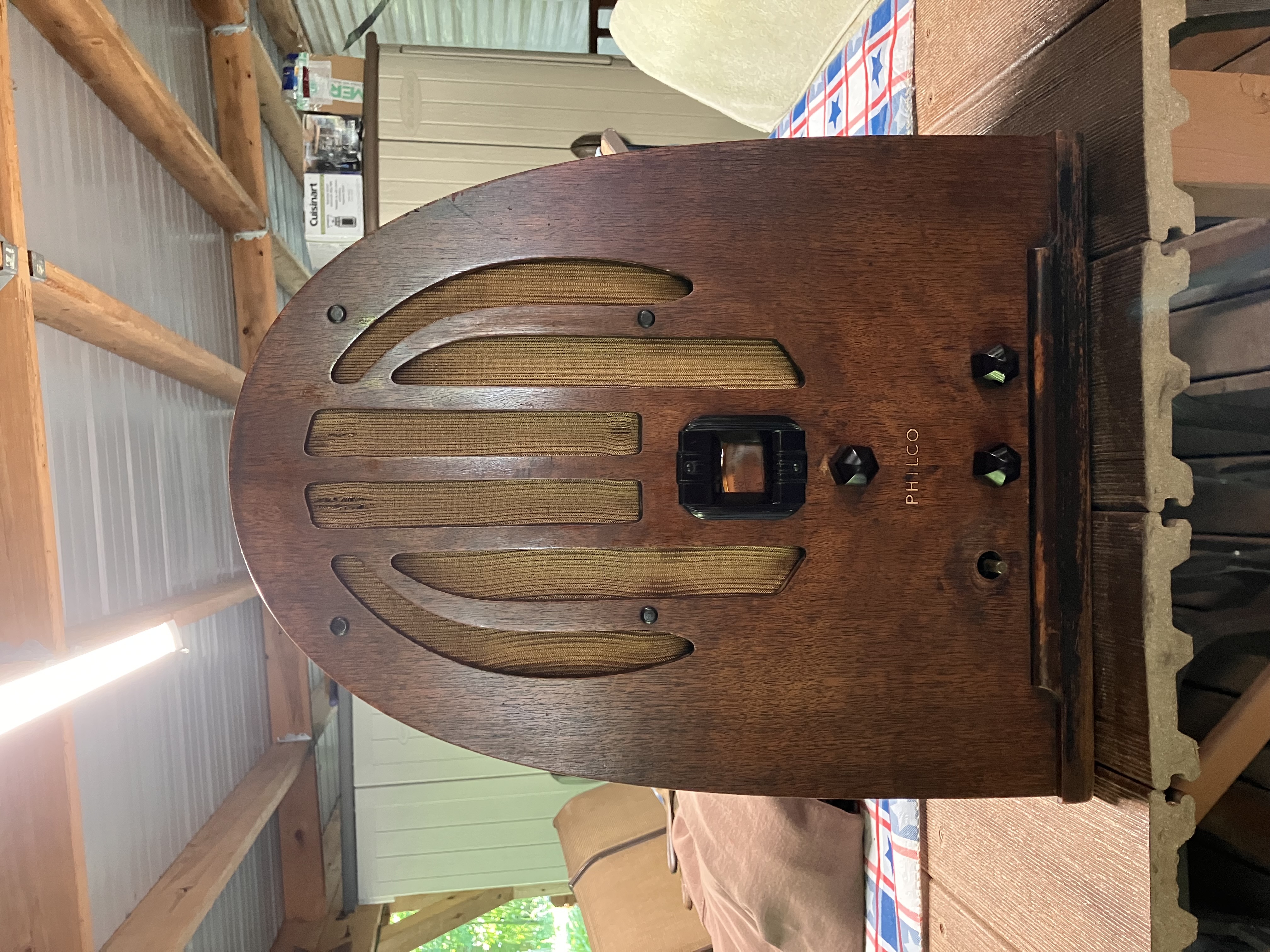
Please take photographs of the back of the cabinet and chassis also. There should be a label with the model number. The problem is that several different chassis may have used this cabinet. In the meantime, I will look at the different models that used this cabinet and get some more info for you.
"Do Justly, love Mercy and walk humbly with your God"- Micah 6:8
"Let us begin to do good"- St. Francis
the three photos you've placed here are exactly the same.
Instead you should photograph the back of the radio, toss 2 out of the three photos you placed here and insert the one of the back.
Then we'll be able to tell you more.
I am not sure why you called it "farm".
The looks fit to models 38 and 60 from year 1936.
People who do not drink, do not smoke, do not eat red meat will one day feel really stupid lying there and dying from nothing.
Okay here is the back, we have the top piece but it needs to be reglued. I’m glad I found this website because trying to research this myself I got misinformation.
Edited- OK, I just saw your new pix. Can you get a good picture of the label inside the cabinet?
If this is a model 38, this is a good performing set, sensitive, with AVC (Automatic Volume Control), similar to utility powered sets. The "Class B" output stage puts out about 2 Watts, similar to many other AC operated table radios.
(Please note that the "38" does not represent 1938, it is the model number.)
Radios designated as "Farm" sets were battery operated because most farms did not have access to utility supplied 115/230V 60Hz AC until the late 1930s to the 1950s, and in some cases, later.
Most farm sets made before 1939 were powered by 3 separate batteries:
A 2.0V lead acid storage battery or 2.5V Eveready "Air Cell", designated as the "A" Battery to power the filaments of the radio tubes. The 2V Lead acid battery had to be brought to "town" to be recharged by the local (?) radio dealer. The 2.5V A battery was disposable and not rechargeable.
A series of 22.5v / 45V batteries, connected in series as the "B" batteries to power the "plate circuits of the radio. These batteries had to be discarded when used up.
A 3V/4.5V/6V/7.5V "C" battery to provide "grid bias" for various circuits. These batteries were also disposable but usually lasted several years.
If your radio is a Model 32, 34, 35, 36, 37 or 38, it uses the above batteries. The best way of powering this set is by using an ARBE III or similar power supply designed to power antique battery radios. Power supplies can be home made but it is rather difficult to build a power supply to deliver 2V DC for the filaments. 3V 'Wall Wart" power supplies are available on the internet, but a series of resistors has to be used to drop the voltage. The value of the resistor depends on what tubes are used in the set.
Later battery sets introduced in late 1938 and 1939 used tubes that operated from a 1.5V A battery and a 90V B Battery, similar to portable battery operated radios introduced at the same times. While relatively sensitive, the power output of the radio was rather low (only about 0.1 - 0.2 Watt with rather low fidelity).
The batteries that powered these sets allowed for maybe about 200 hours or so of listening. The radio was used sparingly, usually for news and farm reports, a Sunday religious service and for the occasional luxury of an entertainment program.
Other "Farm" sets were powered by a 6V car battery and wind powered battery charger and used circuits very similar to car radios of the period, with sensitivity, output power and fidelity on par with most home radios. Other radios were designed to run on 32V DC as some farms had their own 32V DC power plant and bank of batteries.
Hope this is helpful.
"Do Justly, love Mercy and walk humbly with your God"- Micah 6:8
"Let us begin to do good"- St. Francis
Another common way to power the 2v filaments was to use a 6v car battery. These are made up of 3 2v lead acid cells linked together by lead straps linking the cells together in series. You could access them easily from the top so tapping off 2v was a snap.
Have fun chasing electrons!
When my pals were reading comic books
I was down in the basement in my dad's
workshop. Perusing his Sam's Photofoacts
Vol 1-50 admiring the old set and trying to
figure out what all those squiggly meant.
Circa 1966
Now I think I've got it!