Posts: 5,652
Threads: 56
Joined: Sep 2008
City: Sandwick, BC, CA
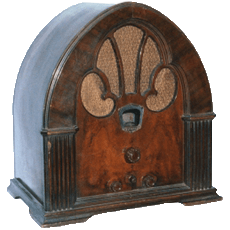
The set appears to be a 1934-35 model, which makes sense as those hex shaped knobs were what Philco was using in those years. Be careful trying to power up the set though, battery tubes, even with 2 volt filaments, are easily to burn out if they get the wrong voltage. The pair of allegator clipped leads are likely for the tube filaments, but it's best to double check in case someone has been playing with things.
Regards
Arran
Posts: 2,327
Threads: 23
Joined: Jul 2020
City: Greenlawn
State, Province, Country: NY
Hi Susie,
I had a very long career providing technical support to clinical laboratory technologists on the use, maintenance and repair of complex laboratory instruments. While these professionals, mostly women, were very intelligent, they were not auto mechanics or electronic engineers but were able to solve most of their problems over the phone without not needing a service call from a field engineer. Don't sell yourself short. Not only can your husband fix anything, so can you!
I am a lifelong suburban New Yorker, living on Long Island in a town about 45 miles from Manhattan, the center of New York City. However, I am very appreciative of Farm Radios, as they provided a very important service to the isolated rural farmer.
First, the good news:
There are many books, You Tube videos, etc. on repairing vintage radios, and most of all, there is the Philco Phorum. We are happy to help you and your husband through this process!
Now, the bad news:
Early Philco sets were notorious for having bad RF, Converter and IF transformers. This is easy enough to diagnose using a VOM (Volt-Ohm Meter) or DVM (Digital Volt Meter). Having a DVM or VOM is a must for servicing electronics. Fortunately, these can be found at reasonable prices.
In one way, Farm sets are more difficult to restore because of the battery power needed. For the Philco Model 38, you need 2V DC for the "filament" (A) supply, 135V DC and 67.5 VDC for the "plate" (B) supplies, and 3VDC and 7.5VDC for the "grid bias" © supply. On the other hand, they did not generate much heat, have more room for servicing, and, depending on where used, they may have been taken out of service while still fully functional upon the availability of electric power.
There are several antique radio power supplies, kits or instructions on building a power supply on the internet. The ARBE III (see arbeiii.com) is the absolute best on the market, but they are very expensive at approximately $160 plus shipping. However, this is an outstanding power supply, with great documentation and great technical support. If you are going to collect antique battery operated radios such as farm sets, old Atwater Kent, Grebe, or other battery operated radios from the 1920s or 1930s, this supply will be a good investment (I have about 15 radios that require this type of supply). Antique Electronic Supply has a usable kit and there are other kits on the internet (eBay, Amazon, etc.) There are also instructions for building power supplies on the internet, but this may not be for folks new to the hobby or with limited electronics experience.
If you don't want to spend a lot of money on a power supply until you determine the condition of this set, you can use modern batteries in the following manner:
5 AAA or AA batteries in a 2 battery holder and a 3 battery holder will handle the C supply. For the B supply, for testing purposes, you can use 15 9V transistor batteries, if you can find a cheap supply. The radio won't play long on these (maybe 5 hours or so, but you can at least use these for testing. Tap between the 7th and 8th battery to get 63V which will suffice for the 67V supply.
The A supply will be the most difficult because you need the most current (500 mA 0r 0.5A) at 2.0V. Since "D" size dry cells provide 1.5V and 2 in series provide 3V, you need to calculate the dropping resistor needed. The good news, is that I am going to do that for you right now:
Below is a chart with each tube in your radio and the current it draws:
1A6 0.060A
32 0.060A
32 0.060A
30 0.060A
19 0.260A
Since these tubes are all connected in parallel, the total draw is 0.5A. Since a resistor has to be added in series to the A Battery connection to the radio to drop the voltage to 2.0V, and current is constant in a series circuit, we need to calculate the resistance needed to drop 1V at 0.5A. So if E=IR then R= E/I. So, if the voltage drop is 1V and the current is 0.5A, then R = 1/0.5 or 2 Ohm. Since the current is constant, in theory a 2 Ohm 1/2 watt resistor is sufficient, use a 2 Ohm resistor at 2 Watt or higher rating.
Since a D Cell delivers only about 1.5Amp Hours, 2 D Cells in series will last 3 hours or less running this radio. 3V 1000 MA "Wall Wart" power supplies can be found for $15.00 or less on the internet. This and the 2 Ohm 2 Watt resistor will power your filaments.
Good luck, don't give up and keep us posted with your progress. Please don't hesitate to ask questions; we are all happy to help!
"Do Justly, love Mercy and walk humbly with your God"- Micah 6:8
"Let us begin to do good"- St. Francis
Best Regards,
MrFixr55
Posts: 9
Threads: 1
Joined: Jul 2025
City: Wittmann
State, Province, Country: AZ
Oh my thank you so much, this will be a good project for the fall and winter. We are in WI now where we spend the Summer. You are a wealth of knowledge. I think with all this detailed information I can encourage my husband to give it a shot! Maybe I’ll even roll up my sleeves Lol.
Kindest regards,
Susan
Posts: 4,832
Threads: 437
Joined: Jun 2011
City: Boston
State, Province, Country: Massachusetts
Just to echo one of the remarks Mr. Fixer made concerning the importance of Farm Radio in rural America in the 30's and 40"s....many people in the US were not on the electrical grid as we now know it. My dad served in the Navy with many of these folks in WW2. Though he was a city kid who never farmed, rode a horse, had not seen an ocean he had something in common with the farm boys. You like Jack Benny? You listen to the Cardinals games? Did you hear the news? Prior to the introduction of the Farm set the news came via word of mouth, US Mail or newspapers. It was a great equalizer linking the nation together in many respects. Radio for rural America was the information superhighway think Sattelite Internet. It was a lens that you could view the world with even through you lived in Buffalo Gap Texas. It was absolutely huge. Have fun fixing up that set.
Paul
Tubetalk1
Posts: 2,327
Threads: 23
Joined: Jul 2020
City: Greenlawn
State, Province, Country: NY
Paul, you said it better than I did. In fact, that sentiment made it into a lot of early RCA Radiola ads.
"Do Justly, love Mercy and walk humbly with your God"- Micah 6:8
"Let us begin to do good"- St. Francis
Best Regards,
MrFixr55
Posts: 9
Threads: 1
Joined: Jul 2025
City: Wittmann
State, Province, Country: AZ
My sister who is 13 years my senior remembers our family having one of these when the family lived in rural Ohio. I am so tickled to get all of this history!
Posts: 2,327
Threads: 23
Joined: Jul 2020
City: Greenlawn
State, Province, Country: NY
Hi Susi,
That's what this hobby and the Philco Phorum are all about!
Attached are a few links to vintage farm radio advertisements from various magazines, for sale on eBay.
As a disclaimer, they are placed here solely for the purpose of education. This is not an endorsement of eBay or a recommendation to buy these ads:
https://www.ebay.com/itm/365740824224?_s...R7rGwPWGZg
https://www.ebay.com/itm/264607109788?va...b46ab47c36
I had a coworker who lived in Canada (We were in a virtual office performing technical support by phone for our complex laboratory instrument customers. He talked about how long it took to get utilities to some of the more remote Canadian farms. They had the "crank" style wall mount phones of the late 1800s to early 1900s in some areas of Canade into the 1970s!
Now with the interest in "off the grid" living, "everything old is new again".
"Do Justly, love Mercy and walk humbly with your God"- Micah 6:8
"Let us begin to do good"- St. Francis
Best Regards,
MrFixr55
Posts: 2,263
Threads: 164
Joined: Jan 2013
City: Westland, MI
Sorry to be so late arriving to the party, and welcome to the Phorum, Susan! As you've already found out this Phorum is all about preserving the past, and helping each other along the way with our projects. We welcome your questions as you restore your radio. Take care, - Gary
P.S. Whereabouts in Wisconsin? I lived in Madison for awhile back in the 80's.
"Don't pity the dead, pity the living, above all, those living without love."
Professor Albus Dumbledore
Gary - Westland Michigan
Users browsing this thread: 1 Guest(s)
|
|
Recent Posts
|
|
Philco P45-6365 Universal Transformer Instruction Manual
|
| Can anyone guide me to where this may be found?GRG — 03:00 PM |
|
54C Complete Teardown/Rebuild
|
| I don't think that I have encountered a 12Z3 before, curious how it uses one of those but includes a #43, which is a 25 ...Arran — 02:17 PM |
|
HiFi (Chifi) tube amp build - but my own design.
|
| It's the other forum. I'm also in DIY, but mostly read there. Honestly, I kinda jumped into this without much thought to...TV MAN — 10:43 AM |
|
Philco 71 Code 125
|
| Hello,
I am in need of a schematic for this radio. Mine has the three separate circular tube shields and a shadow me...dconant — 08:06 AM |
|
Stromberg Carlson 1500 Squeal
|
| And life just keeps getting more complicated.dconant — 07:57 AM |
|
54C Complete Teardown/Rebuild
|
| Hello Roy,
here is this one
sincerely Richardradiorich — 12:45 AM |
|
54C Complete Teardown/Rebuild
|
| Richard,
Had grabbed it already but thank you just the same. I find myself wanting to find some way to block out the...glyphmon — 12:03 AM |
|
54C Complete Teardown/Rebuild
|
| Hello roy,
here is a link to the schematic .
Sincerely Richardradiorich — 11:54 PM |
|
54C Complete Teardown/Rebuild
|
| Richard,
The Silvertone 2014 also is a transformerless set, so I am incorporating a 1:1 600 ohm audio isolation transfo...glyphmon — 11:37 PM |
|
Preliminary work on wife's Silvertone 2014
|
| Did an alignment today which was interesting. IF alignment went great, almost all was already spot-on. Adjusting on th...glyphmon — 11:35 PM |
|
Who's Online
|
There are currently 1298 online users. [Complete List]
» 1 Member(s) | 1297 Guest(s)
|
|
|

|
 
|